
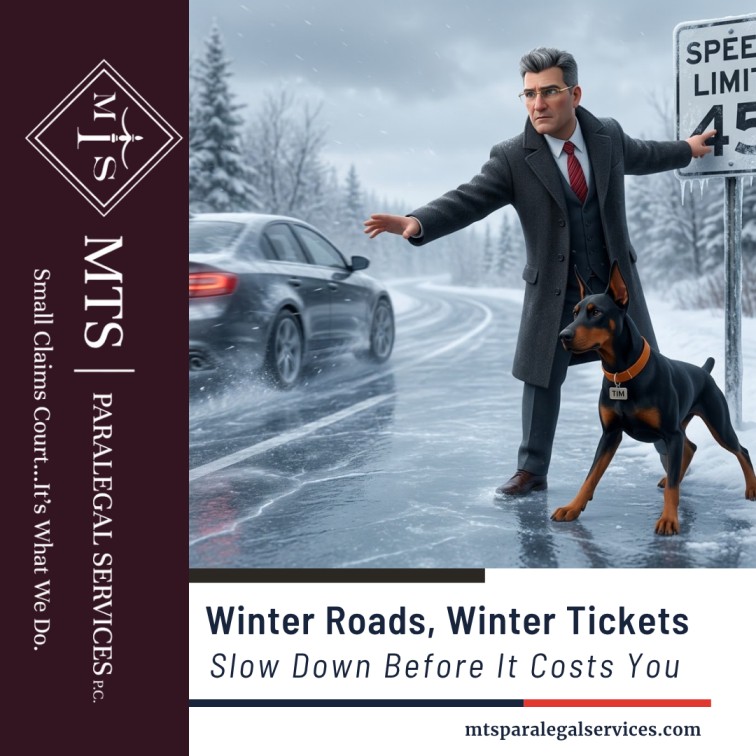
Winter Roads, Winter Tickets: What to Avoid
Ontario winters test every driver, and they test more than skill on slippery roads. The season brings a whole category of tickets that many drivers never consider until an officer is at the window. A windshield only partly cleared, snow sliding off a roof onto the car behind, a careless slide on an icy corner. These are winter-specific offences, and the fines and consequences attached to them are very real. A few minutes with a snowbrush, or a little extra caution behind the wheel, can save a driver from a ticket that follows them for years.
MTS Paralegal Services P.C. defends drivers against traffic charges across Kitchener, Waterloo, Cambridge, Guelph, Hamilton, and Southwestern Ontario. Here are the winter tickets worth avoiding, and what to do if one arrives anyway.
Obstructed View: The Most Common Winter Ticket
The single most frequent winter charge is driving with an obstructed view. Section 74 of the Highway Traffic Act requires that the windshield and the windows on either side of the compartment containing the steering wheel be kept in a condition that gives the driver a clear view to the front and sides. Snow or ice left on the glass, even partially, breaches this requirement, and it is a charge police actively lay every winter. The set fine is modest, commonly around eighty-five dollars before the victim fine surcharge brings it closer to a hundred and ten, but the ticket is easily avoided and easily earned.
Enforcement here comes down heavily to the officer’s judgment of whether the driver had an adequate view. In practice, drivers who scrape only a small porthole in the windshield leave little room for argument, and every winter brings stories of drivers ticketed for peering out through a hand-sized gap in an otherwise snow-covered car. The lesson is simple. Clearing the entire windshield, both front side windows, and the rear window before driving is not just safer, it is the law. An experienced licensed paralegal can assess whether an obstructed view charge was fairly laid, since the standard turns on the officer’s assessment of visibility.
When Snow Flies Off Your Car
The snow a driver leaves on the roof, hood, or trunk does not stay there. At highway speed it lifts off and becomes a hazard to every vehicle behind, and a sheet of ice launching off a roof can shatter a windshield or trigger a collision. Ontario drivers can face charges when snow and ice fly off their vehicle, potentially treated as an insecure load and, where it endangers others, capable of escalating into a far more serious charge. The obligation to clear the vehicle extends well beyond just the windows.
The stakes climb quickly when flying snow or ice actually causes harm. What starts as a failure to brush off the roof can, if it contributes to an accident, become a careless driving charge with consequences in an entirely different league. Commercial vehicles face heightened exposure given their size and the greater danger posed by ice shedding from a large trailer at speed. The few minutes it takes to clear the whole vehicle, roof included, is genuinely the cheapest insurance a winter driver can buy.
Careless Driving: Too Fast for the Conditions
Winter creates a trap that catches even cautious drivers off guard. A driver can be travelling at or below the posted speed limit and still be charged with careless driving under section 130 of the Highway Traffic Act, because the posted limit assumes good conditions. When the road is covered in snow or glazed with ice, the safe speed is often far lower than the sign suggests, and driving too fast for the actual conditions can support a charge even where the speedometer never crossed the limit.
Careless driving is one of the most serious non-criminal charges a driver can face, carrying fines ranging from four hundred to two thousand dollars, six demerit points, a possible licence suspension, and in serious cases even jail, as the firm has explained in its discussion of careless driving. A single winter slide into another vehicle, or a loss of control attributed to excessive speed for the conditions, can produce exactly this charge. The insurance consequences of a careless driving conviction are severe and long-lasting, which makes winter caution not just a safety matter but a financial one.
The Overlooked Ones: Plates, Snowplows, and Snow Tires
A few winter rules slip past most drivers entirely. Licence plates must remain visible and legible, and a plate caked in snow and road salt can itself attract a ticket, so a quick wipe of the plate belongs in every winter clearing routine. Passing a snowplow is another overlooked hazard. Ontario restricts passing snowplows working together in a staggered echelon formation on higher-speed roads, because the plows and their wide blades often occupy more of the road than they appear to, and the rule carries its own fine. The safest course is to stay well back and let the plows do their work.
Snow tires are the rule drivers most often misunderstand. They are not legally required in Ontario, so a driver cannot be ticketed simply for lacking them. However, that does not make them irrelevant to the law. Many insurers offer a discount for installing winter tires during the colder months, and more importantly, a driver whose vehicle slides due to worn or unsuitable tires could find that fact used against them in a careless driving case. The absence of snow tires is not an offence on its own, but it can become part of the story when something goes wrong.
Do Not Let a Winter Ticket Stick
Winter tickets share a common feature that makes them worth challenging. Many of them, from obstructed view to careless driving, rest heavily on an officer’s assessment of the conditions and the driver’s conduct in the moment. That assessment can be examined and, where the evidence is thin or the circumstances were more complicated than the ticket suggests, contested. Paying a winter ticket is a guilty plea that locks in the fine, the demerit points, and the insurance fallout, while contesting it preserves every option.
Timothy Ellis of MTS Paralegal Services P.C. has spent over two decades defending drivers in traffic matters across Southwestern Ontario, including the winter charges that seem minor until the consequences arrive. Anyone ticketed on a snowy road can reach the firm through the contact page at mtsparalegalservices.com before paying anything.
Clear the whole car, slow down for the conditions, and if a ticket still lands, do not just pay it.
Small Claims Court… It’s What We Do.
This content does not constitute legal advice. For up-to-date guidance or legal advice specific to your situation, please contact MTS Paralegal Services Professional Corporation or call (226) 444-4882.