
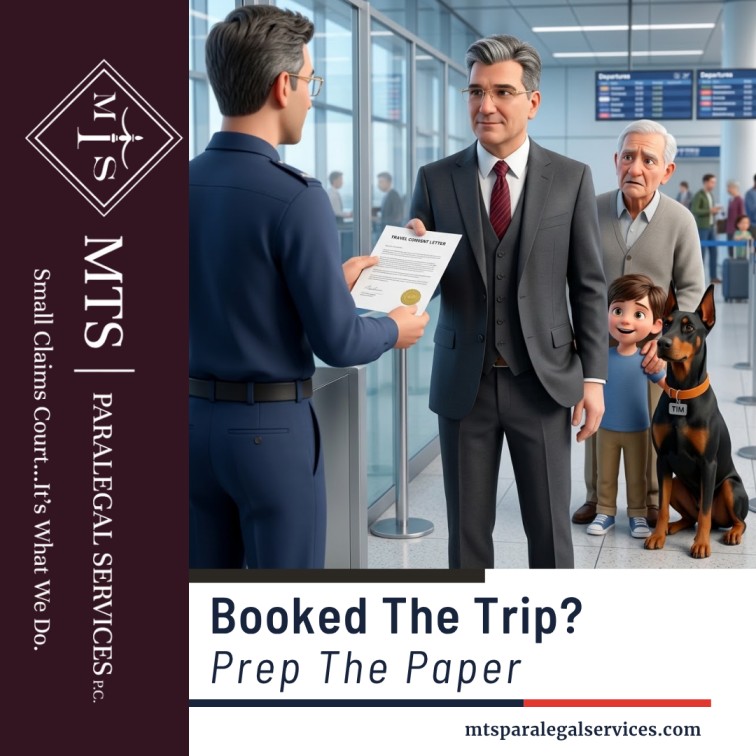
Travel Consent Letters: Do Not Leave Without One
March break, summer vacation, a grandparent’s trip with the grandkids, a school group heading across a border. Every year, thousands of Canadian children travel abroad without both parents, and every year some families are caught off guard at a border because they were missing one simple document. A travel consent letter is not something most people think about until an official asks for it, and by then it is too late to fix. A little preparation before the trip prevents a great deal of stress at the airport.
MTS Paralegal Services P.C. provides notary and commissioning services to families across Kitchener, Waterloo, Cambridge, Guelph, Hamilton, and Southwestern Ontario. Here is what every parent should know about the travel consent letter before booking a trip.
What a Travel Consent Letter Is, and Is Not
A travel consent letter is a document that demonstrates a child travelling abroad has permission to do so from every parent or guardian who is not travelling with them. The Government of Canada, through Global Affairs Canada, publishes a recommended template and even offers a free interactive form to help families create one. The letter confirms who the child is, who they are travelling with, and that the non-accompanying parents or guardians have authorized the trip.
It is important to understand what the letter is not. A travel consent letter is not a legal requirement under Canadian law, and it involves no government processing or permit. That said, both Global Affairs Canada and the Canada Border Services Agency strongly recommend that Canadian children carry one, because many foreign countries and their border officials do ask for documented parental consent before admitting or releasing a minor. The letter is also generally unnecessary for domestic travel within Canada. Where it matters is at international borders, and there it can be the difference between a smooth trip and a serious problem. This is exactly the kind of document an experienced licensed paralegal can help a family prepare and formalize.
When You Need One and Who Should Sign
Global Affairs Canada strongly recommends a consent letter for any Canadian child, meaning anyone under the age of majority, who is travelling abroad alone, with only one parent or guardian, with friends or relatives, or with a group such as a sports team or school trip. The recommendation is to carry a letter for every trip abroad, not just the first one, and not just for lengthy travel. A weekend across the border counts.
The question of who signs matters just as much as having the letter at all. The recommendation is that every non-accompanying parent, guardian, or other person or organization with custody rights, access rights, or parental authority over the child sign the letter. If two parents are together and one travels alone with the child, the other parent should provide a letter. If the child travels without either parent, both parents should sign. This is recommended even where the travelling parent has sole custody, because a border official has no way of knowing the custody arrangement simply by looking. Getting the right signatures on the letter is what gives it its value.
Why Notarizing the Letter Matters
Here is where the letter goes from a piece of paper to a document that carries weight. Notarization is not legally required, and technically any adult who has reached the age of majority can witness the signing. However, both Global Affairs Canada and the Canada Border Services Agency strongly recommend that the letter be witnessed and certified by a notary public, or by an official authorized to administer an oath or solemn declaration. The reason is practical. A notarized letter carries an official seal that border officials are far less likely to question, particularly at destinations with stricter entry requirements for minors.
The format of the letter matters too. Original signed letters are best, and border officials may refuse to accept photocopies or digital versions, or may treat them with suspicion about their authenticity. This is precisely the kind of document MTS Paralegal Services P.C. can notarize and commission for families, adding the certification that makes the letter far more likely to be accepted without difficulty. A few minutes in the office before a trip can spare a family a great deal of anxiety at the border, and Timothy Ellis and the team handle these regularly for travelling families across Southwestern Ontario.
What to Bring and What the Letter Cannot Do
A consent letter rarely travels alone. Families should carry supporting documents that establish the child’s identity and the relationships involved, including the child’s passport and birth certificate. Where the parents are separated or divorced, copies of any custody or access court orders or agreements should accompany the letter. Where one parent has died, a copy of the death certificate helps explain why only one parent has signed. Because a child may also be treated as a citizen of the destination country and subject to its rules, checking that country’s specific entry requirements for minors before travelling is always wise.
It is equally important to be realistic about what a consent letter can accomplish. The letter helps demonstrate permission, but it does not guarantee that a child will be allowed to cross a border, because officials retain the authority to refuse passage where they still have concerns. It is a strong precaution, not an absolute safeguard. One situation falls outside the letter entirely and into family law, which is a separate area from paralegal services: where one parent unreasonably refuses to consent to the child’s travel, the travelling parent may need to seek an order from a family court authorizing the trip. That is a matter for a family law lawyer rather than a consent letter.
Get It Done Right Before You Fly
A travel consent letter is one of those documents that costs almost nothing to prepare and can prevent an enormous amount of trouble. The steps are simple: use the Global Affairs Canada template or interactive form, ensure every non-travelling parent or guardian signs, gather the supporting documents, and have the letter notarized well before the departure date rather than in a last-minute scramble. Handling it early means one less thing to worry about when the trip finally arrives.
MTS Paralegal Services P.C. provides notary and commissioning services for travel consent letters and other documents for families across Southwestern Ontario. For the official template and instructions, families can visit the Global Affairs Canada page at travel.gc.ca, and to have the letter notarized, they can reach the firm through the contact page at mtsparalegalservices.com.
The trip is booked and the bags are packed. Make sure the paperwork is ready too.
Small Claims Court… It’s What We Do.
This content does not constitute legal advice. For up-to-date guidance or legal advice specific to your situation, please contact MTS Paralegal Services Professional Corporation or call (226) 444-4882.