
Suing a Business? Read This Before You File
A business owes you money, delivered defective work, or broke the terms of your agreement, and you are ready to take them to court. Before a single form is filed, there is one question that determines whether the entire case succeeds or collapses: who exactly are you suing? It sounds simple. It is the single most common place where claims against businesses go wrong in Ontario Small Claims Court, and getting it wrong can mean winning a judgment that is worth nothing.
MTS Paralegal Services P.C. has been representing individuals and business owners in commercial disputes across Kitchener, Waterloo, Cambridge, Guelph, Hamilton, and Southwestern Ontario for over 20 years, and this is the guidance every claimant needs before filing against a business.
The Name on the Sign Is Not Always the Name You Sue
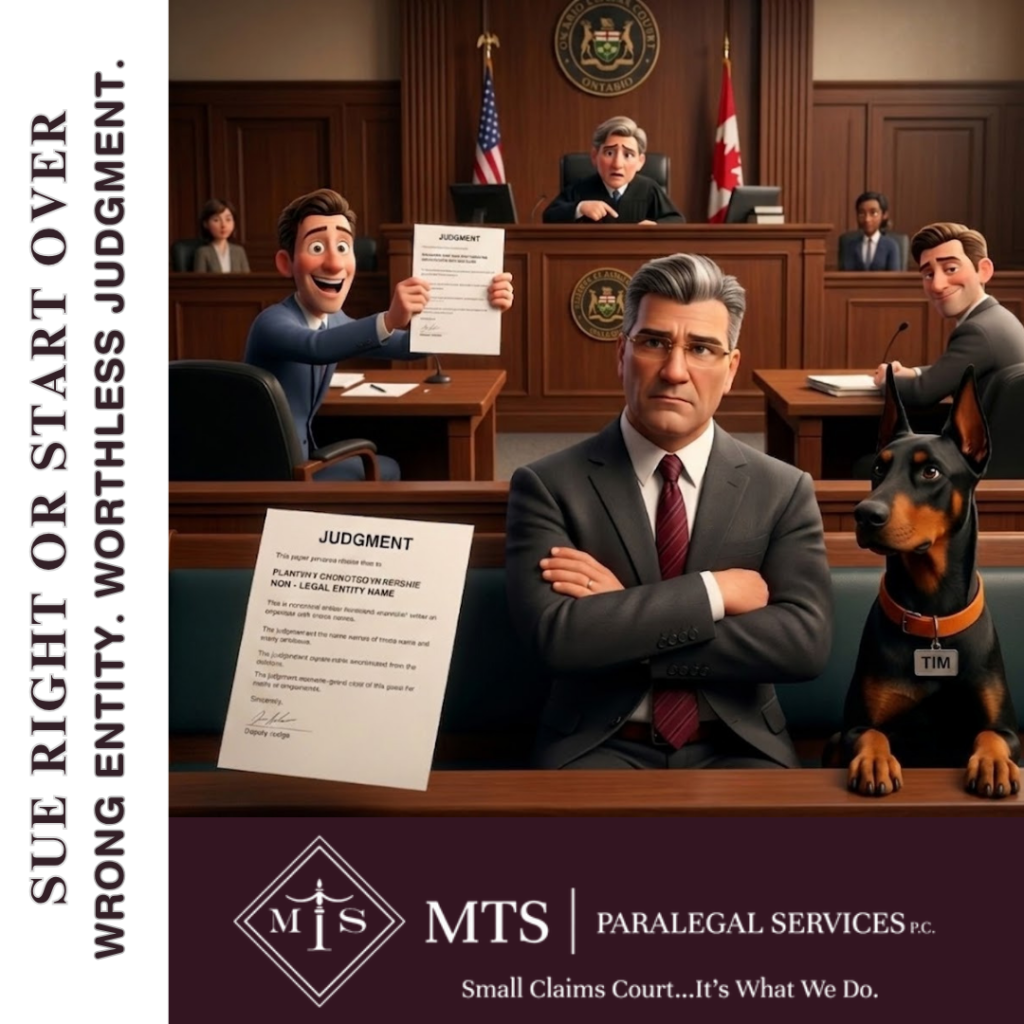
The business name a customer sees on a storefront, an invoice, or a website is very often a trade name, not the legal entity behind it. A company operating as XYZ Contracting might legally be a numbered corporation such as 1234567 Ontario Inc. A claim filed against the trade name alone, when the actual legal entity is a corporation, creates a serious risk that any judgment obtained cannot be enforced against the entity that actually holds the assets.
Confirming the true legal identity of a business before filing is a step that should never be skipped. The Ontario Business Registry allows searches of registered businesses and corporations in the province, and a corporate profile report reveals the exact legal name, status, and registered address of a corporation. That information shapes everything that follows, from the style of cause on the claim to how the judgment is ultimately enforced. An experienced licensed paralegal begins every business claim with exactly this kind of verification.
Corporation, Sole Proprietorship, or Partnership: Why It Matters
The legal structure of the defendant business determines how the claim must be framed. A corporation is a separate legal person, and it must be sued in its full registered corporate name, which typically ends with Incorporated, Limited, Corporation, or an abbreviation of one of those terms. Critically, the debts of a corporation generally belong to the corporation alone. The individual owners are typically not personally liable unless they provided a personal guarantee or other specific circumstances apply.
A sole proprietorship is different. The business and the owner are legally the same person, which means the claim is brought against the individual, commonly styled as the owner carrying on business under the trade name. A partnership can be sued in the partnership’s name. Each structure carries different implications for who pays a judgment and which assets are reachable, and identifying the structure correctly before filing is what separates an enforceable claim from a hollow one.
The Practical Steps Before You File
Once the correct legal entity has been identified, preparation follows the same disciplined path as any strong Small Claims Court matter. Gather every document connected to the dispute: the contract or agreement, invoices, receipts, emails, text messages, photographs of defective work, and records of every attempt to resolve the matter. A well-organized evidence package built early is worth more than any amount of argument delivered later.
A formal demand letter should be sent before filing. It puts the business on notice, states the exact amount claimed and the basis for it, sets a clear deadline, and demonstrates to the court that reasonable efforts were made to resolve the dispute without litigation. Many business disputes resolve at the demand letter stage precisely because a professionally prepared letter signals that the claimant is organized, serious, and ready to proceed. The two-year limitation period under the Limitations Act, 2002 continues running throughout, so the demand letter stage should be prompt and purposeful rather than open-ended.
Winning Is Only Half the Battle: Think About Collection First
A question worth answering before filing any claim against a business is whether the business can actually pay. A judgment against a company with no assets, no active operations, or a trail of existing creditors may be legally valid and practically worthless. Assessing collectability at the outset, including whether the business is still operating, whether it holds assets, and whether anyone personally guaranteed the debt, is part of building a claim that produces real recovery rather than a paper victory.
Where a judgment is obtained and the business does not pay voluntarily, enforcement mechanisms under the Rules of the Small Claims Court include garnishment of the business’s bank accounts and receivables, examination of the debtor, and writs of seizure and sale. As Timothy Ellis of MTS Paralegal Services P.C. reminds every client, a judgment is only as good as the paper it is written on unless it can be enforced. Planning for enforcement before filing is a habit built over two decades of collections and commercial litigation experience.
File It Right the First Time
Claims against businesses fail for avoidable reasons: the wrong entity named, the limitation period missed, the evidence disorganized, or the collectability never assessed. Every one of those risks can be managed with proper preparation, and the cost of getting it right at the start is always lower than the cost of amending a claim, restarting a proceeding, or holding an unenforceable judgment.
MTS Paralegal Services P.C. handles business disputes from the first business name search through to final enforcement, serving clients across Kitchener, Waterloo, Cambridge, Guelph, Hamilton, and Southwestern Ontario. Whether the matter involves an unpaid invoice, defective work, or a broken agreement, the firm brings the preparation and courtroom experience that turns a grievance into a recoverable claim. Reach out through the contact page or call (226) 444-4882 before filing anything.
Sue the right name, build the right case, and collect what you are owed.
Small Claims Court… It’s What We Do.
This content does not constitute legal advice. For up-to-date guidance or legal advice specific to your situation, please contact MTS Paralegal Services Professional Corporation or call (226) 444-4882.