
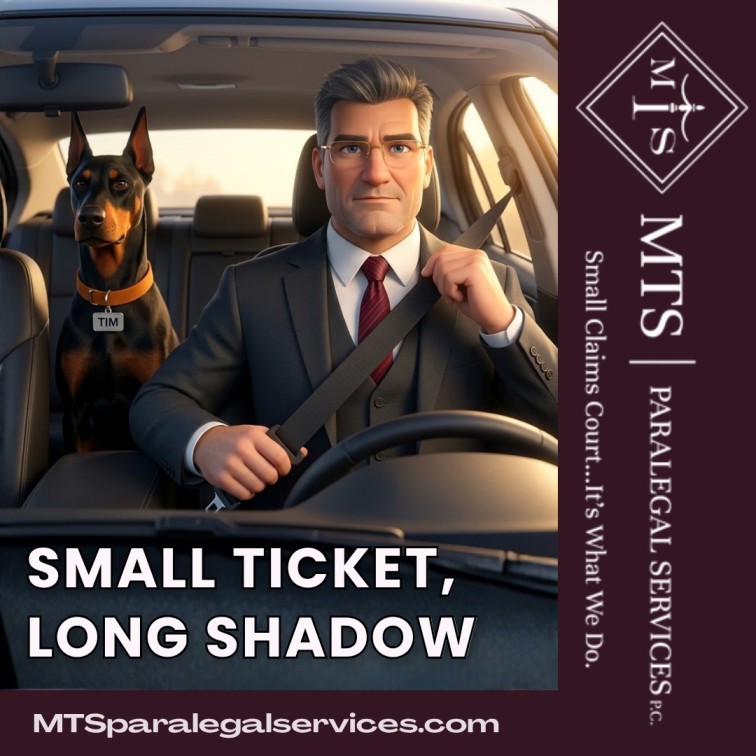
Seatbelt Tickets Are Bigger Than You Think
Of all the tickets an Ontario driver can receive, a seatbelt charge is the one most likely to be shrugged off. It feels minor, almost administrative, and the instinct is to pay it and forget it. That instinct is a mistake. A seatbelt conviction carries demerit points, lands on the driving record for years, and can quietly raise insurance premiums well beyond the value of the original fine. For new drivers, the consequences can be even more serious. This is a charge that is genuinely bigger than it looks.
MTS Paralegal Services P.C. defends drivers against traffic charges across Kitchener, Waterloo, Cambridge, Guelph, Hamilton, and Southwestern Ontario. Here is why a seatbelt ticket deserves far more attention than most drivers give it.
What Section 106 Actually Requires
Seatbelt obligations in Ontario come from section 106 of the Highway Traffic Act, and they extend well beyond simply buckling up. The law requires that every seatbelt in the vehicle be in good working order and worn properly, which means the belt must be snug, worn over the shoulder and across the chest and hips, not tucked under the arm, not slung behind the back, and not twisted. A driver whose belt was on but positioned incorrectly can still be charged, which surprises many people who assumed the belt simply had to be fastened.
The rules reach further still. Ontario follows a one person, one belt principle, meaning a vehicle cannot carry more passengers than it has seatbelts, and each occupant must have their own restrained seating position. It is also an offence to drive a vehicle in which a required seatbelt has been removed, rendered inoperative, or altered, even if no one was relying on that belt at the time of the stop. These provisions catch drivers who never imagined a seatbelt ticket was possible in their situation, and an experienced licensed paralegal can assess whether a charge under section 106 was properly laid.
Who Is Responsible: Drivers, Children, and Adult Passengers
The responsibility for seatbelt compliance is split in a way that carries real risk for drivers. Every driver must wear their own seatbelt, without exception. Beyond that, the driver is legally responsible for ensuring that every passenger under the age of 16 is properly secured, whether by a seatbelt or by the appropriate child car seat or booster for the child’s age and size. If a child under 16 is unbuckled or improperly restrained, it is the driver who is charged, not the child.
Adult passengers are treated differently. A passenger aged 16 or older is individually responsible for wearing their own seatbelt and can be ticketed personally for failing to do so. The important consequence for drivers is that a single traffic stop can generate more than one charge. A driver who is unbuckled, and who also has an improperly restrained child in the back seat, can face multiple convictions from one stop, each carrying its own penalty and demerit points. What looked like a single minor ticket can multiply quickly.
The Real Cost: Demerit Points and the Record
Here is where the ticket proves bigger than it appears. The fine itself is a set fine of around two hundred dollars, which climbs to roughly two hundred and forty once the victim fine surcharge and court costs are added, and it can reach up to one thousand dollars on a conviction dealt with in court. That figure alone is not trivial, but it is the least of the consequences. A seatbelt conviction adds two demerit points to the driver’s record, and it is those points and their downstream effects that do the lasting damage.
A seatbelt conviction remains on the driving record for three years, visible to insurers throughout that period. Insurance companies treat it as a conviction like any other, and premiums can rise at renewal and stay elevated for years, often costing far more over time than the ticket. Drivers of commercial vehicles face an additional layer of exposure, as a seatbelt conviction can carry consequences on their commercial driving record depending on the circumstances. The ticket that seemed like pocket change reveals its true cost only over the following years.
Novice Drivers and the Exemptions That Are Not Escape Hatches
For novice drivers holding a G1, G2, M1, or M2 licence, a seatbelt conviction is more dangerous than it is for a fully licensed driver. Demerit points accumulate against Ontario’s escalating sanctions program for novice drivers, and a new driver has little margin before a suspension becomes a genuine risk, as covered in the firm’s discussion of novice driver rules. A seatbelt ticket that an experienced driver might absorb can push a novice driver a meaningful step toward losing their licence.
The Highway Traffic Act does recognize limited exceptions to the seatbelt requirement, including for a driver moving in reverse, for a person with a valid medical exemption certified by a medical practitioner, and for certain work involving frequent entry and exit from the vehicle at low speeds. These exceptions are narrow, and importantly, a police officer can still issue a ticket even where an exemption may apply. Relying on an exemption often means having to establish it properly in court, with the right documentation, rather than assuming it will prevent a charge from ever being laid.
Yes, You Can Fight It
A persistent myth holds that seatbelt tickets cannot be contested. That is simply not true. Because these charges frequently rest on an officer’s observation through car windows, often at a distance and in less than ideal conditions, there is genuine room to challenge them. Window tint, glare, lighting, the driver’s clothing, the colour of the belt, the angle of the officer’s view, and questions about whether the belt was adjusted before or after the stop can all bear on whether the charge holds up. The precise wording of the charge and the details of proper use matter too.
Given the two demerit points, the three years on the record, the insurance impact, and the heightened risk for novice drivers, contesting a seatbelt ticket is often well worth it. Paying the fine is a guilty plea that locks in every consequence. Timothy Ellis of MTS Paralegal Services P.C. has spent over two decades defending drivers in traffic matters across Southwestern Ontario, examining exactly these details. Anyone holding a seatbelt ticket can reach the firm through the contact page at mtsparalegalservices.com before paying anything.
A seatbelt ticket looks small. What follows it is not. Fight the charge.
Small Claims Court… It’s What We Do.
This content does not constitute legal advice. For up-to-date guidance or legal advice specific to your situation, please contact MTS Paralegal Services Professional Corporation or call (226) 444-4882.