
Rolled the Stop Sign? Here Is the Real Cost
Almost every driver has done it. Approaching a quiet intersection, the vehicle slows to a crawl, the coast looks clear, and it rolls through the stop sign without ever fully stopping. It feels harmless, even sensible. Ontario law sees it very differently. That rolling stop is treated exactly the same as blowing through the sign at speed, and the ticket that follows carries a real cost that reaches well past the modest fine printed on it. Understanding what a stop sign charge actually costs is the first step to deciding what to do about one.
MTS Paralegal Services P.C. defends drivers against traffic charges across Kitchener, Waterloo, Cambridge, Guelph, Hamilton, and Southwestern Ontario. Here is the real cost of rolling a stop sign.
What Counts as a Legal Stop
The rule comes from section 136 of the Highway Traffic Act, which requires a driver approaching a stop sign to come to a complete stop at a specific place. The law sets out three locations in order of priority. A driver must stop at the marked stop line. If there is no stop line, the driver must stop immediately before the nearest crosswalk. If there is no crosswalk either, the driver must stop immediately before entering the intersection. After stopping, the driver must yield to any traffic that is close enough to be a hazard before proceeding.
What the law means by a stop is precise. A complete stop means the wheels of the vehicle come to a full standstill, with no forward motion at all. Interestingly, the Highway Traffic Act does not specify a number of seconds a driver must remain stopped, despite the common belief that three seconds is required. Three seconds is a useful habit taught by driving instructors, not a legal requirement. What the law demands is that the wheels genuinely stop moving, and stop in the correct location. A driver who stops past the line or past the crosswalk can be charged just as a driver who never stopped at all.
The Rolling Stop Trap
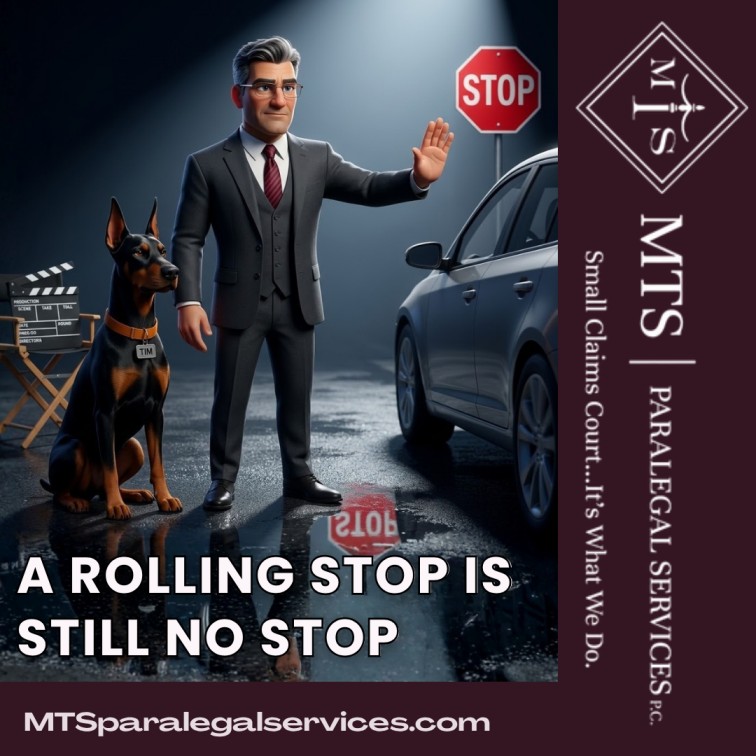
This is where most drivers get caught out. A rolling stop, sometimes called a Hollywood stop, is when a vehicle slows down at a stop sign but never quite comes to a full halt before continuing. Drivers often believe that slowing enough to look both ways satisfies the law. It does not. Under the Highway Traffic Act, a rolling stop is legally treated the same as failing to stop at all. If the wheels were still turning, even slightly, the requirement was not met, and the charge can stand.
Stop sign offences are typically charged based on a police officer’s direct observation, and increasingly on dashcam footage as well. An officer positioned at an intersection watches for exactly this behaviour, and what feels to the driver like a reasonable slowdown can look, from the officer’s vantage point, like a clear failure to stop. Because the entire case often rests on that observation, the specifics matter enormously. Where the evidence about whether the wheels actually stopped is unclear, there may be genuine room to challenge the charge, which is exactly the kind of detail an experienced licensed paralegal examines closely.
The Real Cost Behind the Fine
The fine for a stop sign ticket is deceptively small, typically a set fine of around eighty-five dollars that comes to roughly one hundred and ten dollars once the victim fine surcharge and court costs are added. That modest number is what convinces so many drivers to simply pay it and move on. The genuine cost lives elsewhere. A conviction for disobeying a stop sign adds three demerit points to the driver’s record, and it is the demerit points and the insurance consequences that do the real damage.
Those three demerit points remain active on the record for two years from the date of the offence, while the conviction itself stays visible to insurers and other third parties for around three years. Insurance companies treat a stop sign conviction as a mark against the driver, and premiums can rise for the full period the conviction is visible, often costing far more over time than the original fine. Where the ticket was issued in connection with a collision, the insurance impact is heavier still. Drivers of commercial vehicles face an additional layer, as the conviction can also carry consequences on their commercial driving record. The ticket that looked like pocket change can quietly become one of the more expensive line items in a driver’s budget.
Extra Risk: Community Safety Zones and Novice Drivers
Two situations raise the stakes considerably. The first is location. A stop sign offence committed within a Community Safety Zone, which often surrounds schools and other sensitive areas, carries significantly higher fines than the same offence on an ordinary road, as the firm has noted in its discussion of school zone driving. The demerit points remain the same, but the financial penalty climbs, and the presence of these zones is easy to miss until a ticket arrives reflecting the elevated fine.
The second is the driver’s licence class. For novice drivers holding a G1, G2, M1, or M2 licence, demerit points carry heightened danger because they accumulate toward Ontario’s escalating sanctions program. A new driver already operates with little room before a suspension becomes a real risk, and a stop sign conviction eats into that margin quickly. What is a manageable annoyance for a seasoned driver with a clean record can be a serious step toward suspension for a novice. Both circumstances are strong reasons not to treat a stop sign ticket as automatically not worth contesting.
Why This Ticket Is Worth Fighting
Given how much a stop sign conviction can cost in demerit points and insurance over three years, and given that the charge frequently hinges on a single officer’s split-second observation, this is a ticket that deserves a proper second look rather than an automatic payment. Paying the fine is a guilty plea that locks in every consequence, while contesting it preserves the chance to examine the evidence, question whether a complete stop truly did not occur, and pursue a resolution that protects the driving record.
Timothy Ellis of MTS Paralegal Services P.C. has spent over two decades defending drivers in traffic matters across Southwestern Ontario, scrutinizing exactly these kinds of observation-based charges. Before paying a stop sign ticket and accepting the demerit points and insurance fallout that come with it, anyone charged can reach the firm through the contact page at mtsparalegalservices.com to understand their options.
A rolling stop feels like nothing. The conviction is not nothing. Fight the ticket.
Small Claims Court… It’s What We Do.
This content does not constitute legal advice. For up-to-date guidance or legal advice specific to your situation, please contact MTS Paralegal Services Professional Corporation or call (226) 444-4882.