Notary Public: What They Actually Do
Most people encounter a Notary Public at the exact moment they need one, and not a day earlier. An overseas transaction requires a form. A diploma needs a certified copy. A child’s travel consent letter has to be signed. Suddenly the hunt is on for someone with the right stamp. Yet what that stamp actually certifies, and what a notary is genuinely authorized to do, stays a mystery to nearly everyone who depends on it. Worth noting as well: notarization has to happen in person. You cannot get a document notarized over a video call.
MTS Paralegal Services P.C. provides notary and commissioning services to individuals and businesses across Kitchener, Waterloo, Cambridge, Guelph, Hamilton, and Southwestern Ontario. Here is what the role actually involves and when it matters.
The Authority Behind the Seal
A Notary Public in Ontario is a public officer whose authority comes from the Notaries Act, R.S.O. 1990, c. N.6. A notary can administer oaths and affirmations, take affidavits and statutory declarations, certify true copies of original documents, witness and authenticate signatures, and prepare notarial certificates for documents destined for use both inside and outside Canada.
The role sits above the Commissioner of Oaths in the hierarchy of document officials. Every notary can do everything a commissioner can do, but the reverse is not true. The powers that belong exclusively to the notary, certifying true copies and authenticating documents for international use chief among them, are precisely the ones that matter most for cross-border and institutional paperwork. MTS Paralegal Services P.C. has covered the commissioner side of this distinction before, and the practical rule remains simple: when a document is leaving the country or requires a certified copy, a notary is the professional the situation calls for.
Certified True Copies: The Everyday Workhorse
The certified true copy is the notary service Ontarians use most. Institutions frequently demand proof of a document without surrendering the original: universities want degree verification, foreign governments want passport copies, lenders want identification records, and regulators want licences on file. The notary examines the original document, compares the copy against it, and certifies that the copy is a true copy of the original presented.
The certification speaks to the copy, not the content. A notary certifying a copy of a diploma is confirming the copy matches the original, not vouching for the academic record behind it. That distinction is the quiet boundary running through all notarial work: the seal verifies the process that occurred in front of the notary, never the underlying truth of what a document asserts. Anyone attending for certified copies should bring the original documents and valid government-issued photo identification, because the notary must see both.
Documents Going Abroad: The Apostille Era
International document handling changed significantly when Canada joined the Hague Apostille Convention, which came into force for Canada on January 11, 2024. Before that date, an Ontario document destined for a foreign country typically needed authentication followed by legalization at the destination country’s consulate, a slow two-step chain. For the many countries that belong to the Convention, a single certificate called an apostille now replaces that entire process.
In Ontario, apostilles are issued by Official Documents Services, the provincial competent authority, and notarized documents are a primary route into that system. The notary’s registered seal and signature is what Official Documents Services certifies, which is why documents prepared for international use generally must pass through a Notary Public rather than a Commissioner of Oaths. Powers of attorney for foreign transactions, certified copies of credentials for work abroad, statutory declarations for foreign marriage or immigration processes, and consent letters all commonly travel this path. Confirming the destination country’s exact requirements before starting remains essential, because requirements vary and the recipient always has the final say.
The Everyday Situations That Call for a Notary
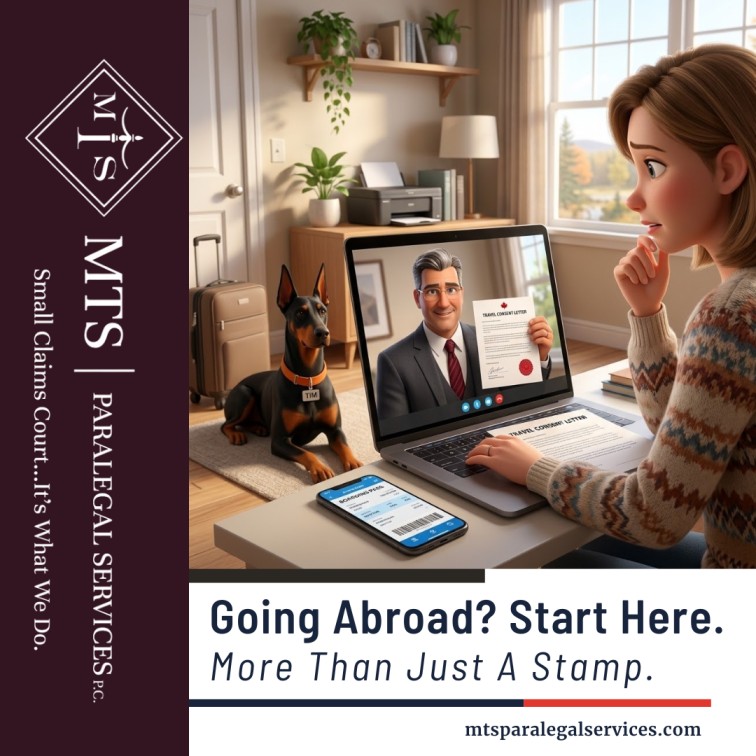
Beyond international paperwork, notarial services thread through ordinary life more often than people expect. Travel consent letters for a minor travelling with one parent or a group reduce the risk of border delays. Statutory declarations support name change processes, insurance claims, pension applications, and government filings. Invitation letters for visitors applying for visas, declarations of marital status, and authorized signatures on institutional forms all regularly require a notary’s involvement.
What every one of these services shares is the same core mechanics: the person appears before the notary, presents valid photo identification, and signs or swears in the notary’s presence. Signing a document beforehand and presenting it as complete defeats the entire purpose of the process and can render the document invalid. The appointment is short, but the presence requirement is not optional.
A Notary with Legal Experience Behind the Seal
Plenty of places can stamp a document. What MTS Paralegal Services P.C. brings to notarial work is the judgment that comes from more than two decades of legal practice. Timothy Ellis and the firm handle notarizations and commissioning with the same care applied to every Small Claims Court file, which means documents are reviewed properly, executed correctly, and fit for the purpose they are meant to serve the first time.
Anyone needing a document notarized, a copy certified, or guidance on preparing paperwork for use abroad can reach the firm through the contact page or at mtsparalegalservices.com to arrange an appointment.
The stamp takes a second. Getting it right is what you are actually paying for.
Small Claims Court… It’s What We Do.
This content does not constitute legal advice. For up-to-date guidance or legal advice specific to your situation, please contact MTS Paralegal Services Professional Corporation or call (226) 444-4882.