
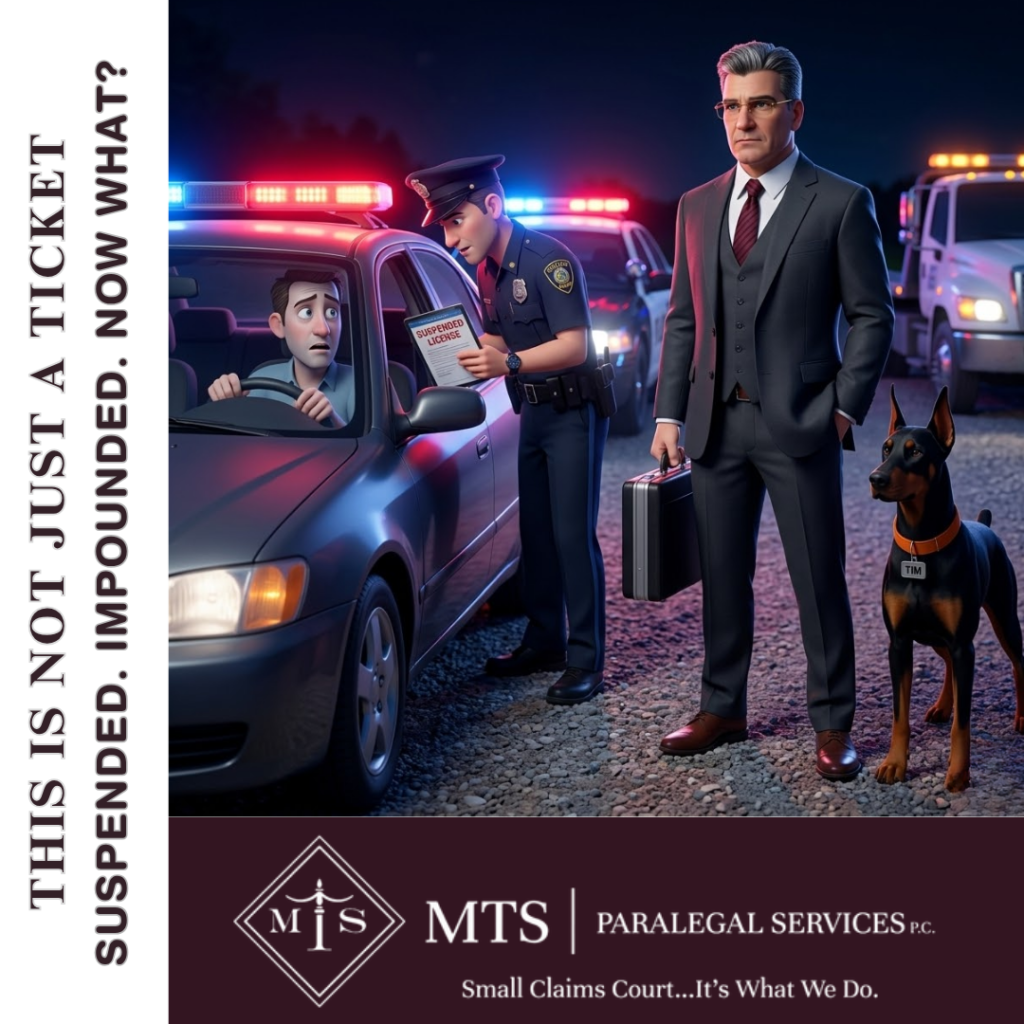
Driving Under Suspension in Ontario: What You Need to Know
A suspended licence is not a suggestion. Under Ontario law, driving while a licence is under suspension is a serious provincial offence that carries immediate and lasting consequences, including significant fines, an automatic additional licence suspension, vehicle impoundment, and the possibility of imprisonment. Yet every year, drivers across Ontario face this charge, sometimes knowingly and sometimes without realizing their licence was suspended at all.
MTS Paralegal Services P.C. represents clients facing traffic charges across Kitchener, Waterloo, Cambridge, Guelph, Hamilton, and Southwestern Ontario, and driving under suspension is among the most consequential matters the firm regularly handles. Understanding exactly what this charge means, what it carries, and what options exist is essential for anyone facing it.
What Is Driving Under Suspension in Ontario?
Driving under suspension is a provincial offence under section 53 of the Highway Traffic Act, R.S.O. 1990, c. H.8. The section makes it an offence for any person to operate a motor vehicle on a highway while their driver’s licence is suspended under any Act of the Legislature or regulation made under it. The charge applies regardless of the reason the suspension was imposed and regardless of whether the driver was aware the suspension was in effect.
It is important to understand that driving under suspension under section 53 of the Highway Traffic Act is a provincial offence, not a criminal matter under the Criminal Code of Canada. A conviction does not result in a criminal record. However, it is a significantly more serious charge than a standard traffic ticket, and persons who receive a summons under this section must appear in court. Failing to appear can result in a warrant being issued. A separate and distinct Criminal Code offence, driving while disqualified, applies in circumstances involving court-ordered driving prohibitions and carries considerably harsher penalties. The two charges are legally distinct and should not be confused.
What Triggers a Licence Suspension in Ontario?
Licence suspensions in Ontario arise from a range of circumstances, and a driver may find themselves suspended for reasons they are not immediately aware of. Common triggers include accumulating too many demerit points under the Highway Traffic Act, failing to pay outstanding fines, being convicted of a serious driving offence, a medical condition that renders a driver unsafe to operate a vehicle, or an administrative licence suspension issued at the roadside in connection with an alcohol or drug-related incident.
Suspensions are administered by the Ontario Ministry of Transportation and are communicated to the address on file with the Ministry. A driver who has moved without updating their address may not receive the suspension notice and may continue driving without realizing their licence has been suspended. Ontario law does not provide a defence based on a lack of knowledge of the suspension. Ignorance of a suspension does not negate the offence under section 53 of the Highway Traffic Act, which is why checking the status of a licence through ServiceOntario is strongly advisable for any driver who has outstanding fines, recent convictions, or unresolved licence issues.
What Are the Penalties Upon Conviction?
The penalties for a conviction under section 53(1) of the Highway Traffic Act are among the most significant available under Ontario’s provincial offences framework. For a first offence, the mandatory minimum fine is $1,000 and the maximum is $5,000. For subsequent offences, the mandatory minimum fine increases to $2,000, with the maximum remaining at $5,000. In either case, a term of imprisonment of up to six months may also be imposed. Upon conviction, an automatic additional six-month licence suspension is imposed by operation of the statute, independent of whatever suspension was already in effect.
Where the underlying suspension relates to an alcohol or drug-related driving matter, the penalties under section 53(1.1) of the Highway Traffic Act are significantly more severe. A first offence in those circumstances carries a mandatory minimum fine of $5,000 and a maximum of $25,000. Subsequent offences carry fines ranging from $10,000 to $50,000, plus the possibility of imprisonment. Vehicle impoundment is also an immediate consequence of being charged with driving under suspension, with impoundment costs payable by the driver regardless of the outcome of the charge at court. These costs can be substantial and arise before any court proceeding takes place.
The Driving Record and Insurance Consequences
A conviction under section 53 of the Highway Traffic Act is recorded with the Ontario Ministry of Transportation and appears on the driver’s abstract. Insurance companies review driving abstracts at renewal and treat a driving under suspension conviction as a serious risk indicator. Premium increases following such a conviction can be substantial, and some insurers may decline to renew a policy entirely, leaving the driver to seek coverage at significantly higher rates in the non-standard insurance market.
The conviction remains on the driving record and continues to affect insurance premiums for several years following the date of conviction. Combined with the extended licence suspension, impoundment costs, and fines, the total financial impact of a driving under suspension conviction is far greater than the fine itself suggests. For commercial drivers, professional drivers, or anyone whose employment requires a valid licence, the consequences extend further still, potentially affecting their ability to earn income during and after the suspension period.
Is There a Defence and What Should You Do Next?
Driving under suspension is classified as a strict liability offence under Ontario law, which means the Crown does not need to prove that the driver intended to drive while suspended. However, strict liability offences can still be defended. Recognized defences include a reasonable mistake of fact, due diligence, and officially induced error, which arises where a driver was given incorrect information by an official authority that led them to reasonably believe their licence was valid. Every file is fact-specific, and the circumstances surrounding the charge determine what defences may be available.
Anyone who has been charged with driving under suspension under section 53 of the Highway Traffic Act should seek qualified legal advice immediately. Timothy Ellis of MTS Paralegal Services P.C. has been defending clients against serious traffic charges across Kitchener, Waterloo, Cambridge, Guelph, Hamilton, and Southwestern Ontario for over 20 years. A thorough review of the file, the circumstances of the suspension, and the facts of the charge is the foundation of any meaningful defence. Reach out through the contact page or call (226) 444-4882 before the court date arrives.
This is not the kind of charge to walk into alone.
Small Claims Court… It’s What We Do.
This content does not constitute legal advice. For up-to-date guidance or legal advice specific to your situation, please contact MTS Paralegal Services Professional Corporation or call (226) 444-4882.