
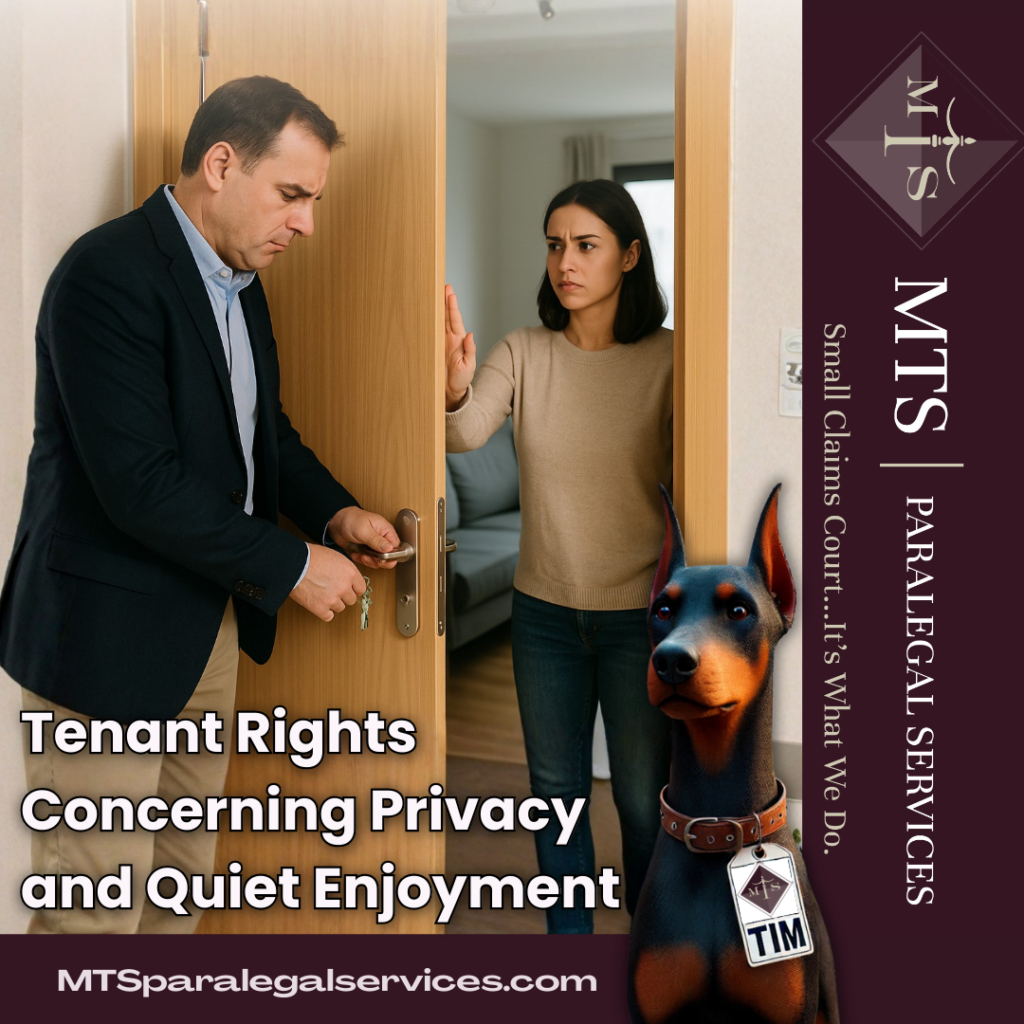
Tenant Rights Concerning Privacy and Quiet Enjoyment
In Ontario, tenants are entitled to occupy their rental premises free from undue interference by landlords or others acting on their behalf. This entitlement arises under the Residential Tenancies Act, 2006 (RTA) and forms part of the broader legal principle known as the right to quiet enjoyment.
Section 22 of the RTA provides that a landlord shall not substantially interfere with a tenant’s reasonable enjoyment of the rental unit or the residential complex. This protection extends beyond mere noise concerns—it encompasses the right to privacy, freedom from harassment, and the ability to use the premises safely and peacefully.
Tim at MTS Paralegal Services assists tenants in understanding these rights and, when necessary, initiating applications before the Landlord and Tenant Board (LTB) to obtain remedies for violations.
The Right to Privacy in Rental Housing
A tenant’s right to privacy is a central aspect of Ontario tenancy law. Once a tenancy begins, the rental unit becomes the tenant’s private residence, and the landlord’s access to it is strictly regulated.
Under Section 27 of the RTA, landlords may enter a rental unit only under specific conditions:
- With written notice at least 24 hours in advance, stating the reason for entry, the date, and the time (between 8 a.m. and 8 p.m.);
- Without notice in emergencies, such as fire, flood, or threats to safety;
- With the tenant’s consent, given at the time of entry;
- For showing the unit to prospective tenants or purchasers, with proper notice and within reasonable hours; or
- As permitted by a court order or LTB order.
Any entry outside these conditions constitutes an unlawful intrusion and may give rise to a tenant rights claim.
Tim at MTS Paralegal Services advises tenants on documenting and responding to unlawful entries, including the collection of evidence such as written communications, photographs, or witness statements.
Understanding Quiet Enjoyment
The term “quiet enjoyment” is often misunderstood. It does not guarantee absolute silence but rather the right to live without substantial interference from the landlord or others. Common breaches of this right include:
- Repeated, unauthorized visits by the landlord or property manager;
- Harassment, intimidation, or verbal abuse;
- Construction noise or repairs conducted at unreasonable hours;
- Failure to address disruptive tenants or common-area disturbances;
- Unreasonable interference with utilities such as water, heat, or electricity;
- Neglect that results in unsafe or uninhabitable living conditions.
The LTB has consistently recognized that the right to quiet enjoyment encompasses both physical comfort and psychological security. This means that even non-physical interference, such as repeated threats or invasion of personal space, may constitute a violation.
Remedies for Breach of Privacy or Quiet Enjoyment
Tenants who experience violations of privacy or quiet enjoyment have several legal remedies available under the RTA. The most common mechanism is filing an Application about Tenant Rights (Form T2) before the LTB.
Through this process, tenants may seek:
- An order restraining the landlord from continuing the unlawful conduct;
- Compensation for loss of enjoyment, inconvenience, or property damage;
- Abatement of rent for the period of interference;
- Administrative fines against the landlord for serious or repeated violations; or
- Termination of the tenancy agreement, where the interference makes continued occupancy intolerable.
The tenant must present clear evidence of the interference, its impact, and the landlord’s knowledge or participation. Tim at MTS Paralegal Services assists in drafting applications, gathering supporting documentation, and presenting the case effectively at hearings.
Harassment and Retaliation
Under Section 23 of the RTA, landlords are expressly prohibited from harassing, coercing, or threatening tenants. Harassment includes any conduct that creates a hostile or intimidating living environment, such as repeated phone calls, surveillance, or unjustified eviction threats.
Additionally, the RTA forbids retaliation against tenants who exercise their legal rights. For example, a landlord cannot lawfully raise rent, issue an eviction notice, or reduce services because a tenant filed a complaint or application with the LTB.
Where such conduct occurs, tenants may bring a retaliation claim under Section 83(3) of the RTA, requesting that the LTB refuse or delay eviction proceedings initiated in bad faith. Tim at MTS Paralegal Services provides representation in these matters to ensure tenants are protected from unlawful reprisals.
Evidence and Documentation
Proving a breach of privacy or quiet enjoyment requires organized and credible evidence. Tenants are advised to maintain:
- A written log of incidents, dates, and times;
- Copies of emails, texts, or letters sent to the landlord;
- Witness statements from neighbours or visitors;
- Photographs or audio recordings, where permissible by law;
- Documentation of complaints to by-law enforcement or building management.
Accurate and detailed evidence strengthens a tenant’s position before the LTB and increases the likelihood of a successful outcome. Tim at MTS Paralegal Services assists in evaluating evidence and preparing persuasive submissions for adjudication.
Preventive Measures and Professional Advice
Open communication often prevents conflicts from escalating. Tenants are encouraged to address concerns in writing, clearly outlining the issue and requesting resolution. Should the landlord fail to respond or continue the offending behaviour, formal legal action may become necessary.
Professional guidance ensures that applications are filed correctly and that procedural rules are followed. Tim at MTS Paralegal Services provides experienced representation to ensure tenants’ statutory rights are enforced and respected under Ontario law.
Legal Support from MTS Paralegal Services
Every tenant in Ontario is entitled to privacy, safety, and peaceful enjoyment of their home. When these rights are violated through harassment, unlawful entry, or disruptive interference, legal recourse is available under the Residential Tenancies Act.
Tim at MTS Paralegal Services, located in Kitchener, Ontario, represents tenants across the province in cases involving privacy violations, harassment, and denial of quiet enjoyment. With a detailed understanding of Ontario’s tenancy laws and LTB procedures, Tim ensures that claims are effectively prepared and presented.
If your landlord is violating your right to privacy or quiet enjoyment, timely action is essential to preserve your rights. Contact Tim at MTS Paralegal Services — Small claims court, it’s what we do. Visit mtsparalegalservices.com for professional legal support.
This content does not constitute legal advice. For up-to-date guidance or legal advice specific to your situation, please contact MTS Paralegal Services Professional Corporation or call (226) 444-4882.