
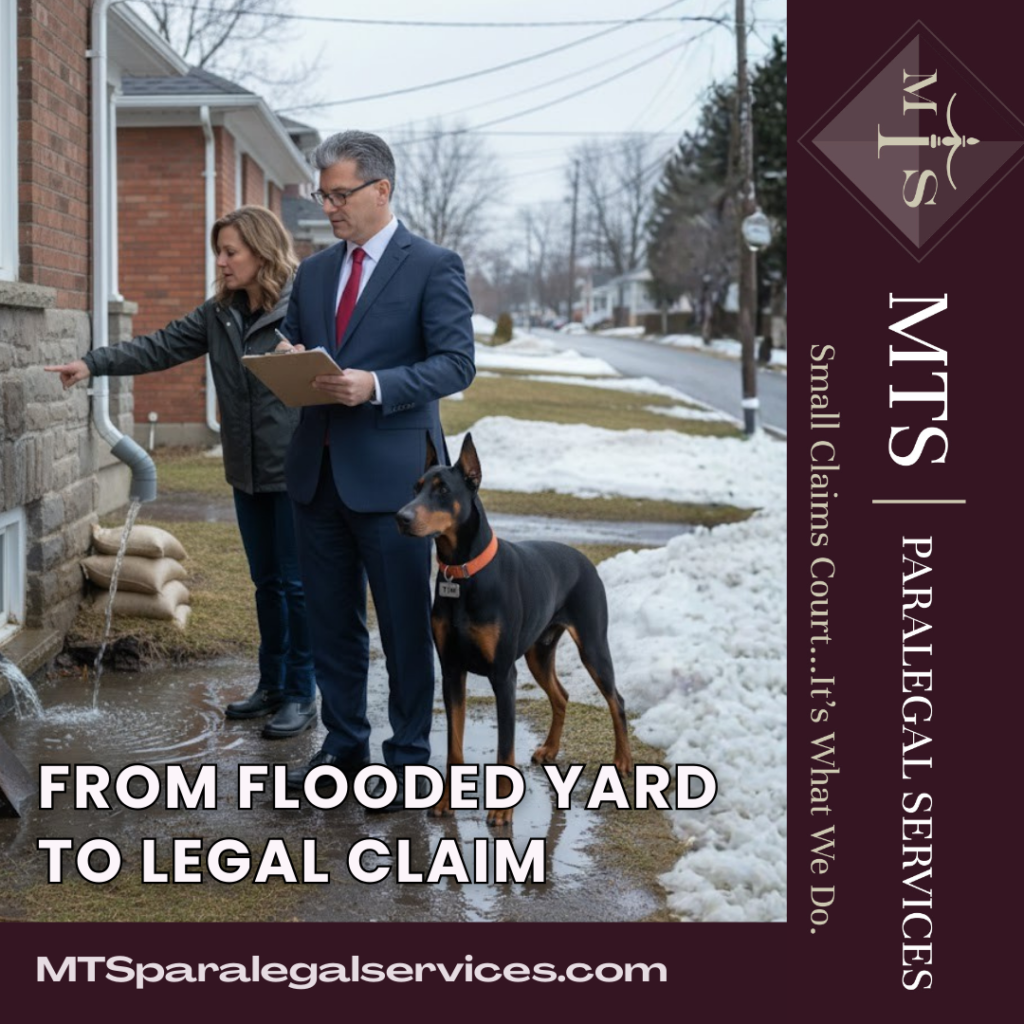
Proving Property Damage from Melting Snow and Flooding
Seasonal transitions in Ontario frequently bring significant thawing, rapid snowmelt, and heavy rainfall. While these natural processes are predictable, the property damage that may follow is often disputed. Proving property damage from melting snow and flooding requires more than photographs and frustration. It demands structured evidence, legal causation, and procedural precision. MTS Paralegal Services Professional Corporation routinely assists clients in assessing liability and advancing claims arising from water intrusion and related loss.
Establishing Legal Responsibility for Water Damage
Property damage claims arising from melting snow and flooding typically engage principles of negligence, nuisance, and occupiers’ liability. The central legal question is whether another party owed a duty of care and failed to meet the applicable standard, thereby causing compensable harm.
In residential and commercial contexts, liability may arise where a property owner fails to maintain drainage systems, clear snow accumulation from roofs, repair foundation defects, or ensure proper grading around a structure. Municipal liability may also be implicated in limited circumstances, particularly where stormwater infrastructure is demonstrably deficient and statutory notice requirements are satisfied.
To succeed in litigation, a claimant must establish, on a balance of probabilities, that the defendant’s breach of duty directly caused the water damage. Natural thawing alone does not automatically create liability. The claimant must demonstrate that the damage was foreseeable and preventable through reasonable maintenance or care.
Documenting the Damage and Causation
The evidentiary burden in property damage litigation is substantial. Immediate documentation is essential. Photographs and video recordings should capture the extent of flooding, points of water entry, damaged personal property, and structural deterioration. Maintenance records, prior inspection reports, and correspondence regarding complaints may further support the claim.
Expert evidence may be necessary to establish causation. For example, an engineer or building inspector may provide an opinion regarding improper grading, blocked weeping tiles, defective eavestroughs, or foundation cracks. Such expert analysis assists the court in distinguishing between unavoidable natural conditions and negligent maintenance.
Financial documentation is equally critical. Repair estimates, invoices, insurance correspondence, and proof of replacement costs quantify damages. Courts require objective proof of monetary loss. Unsupported assertions rarely satisfy the evidentiary threshold.
Timeliness is another essential component. The Limitations Act, 2002 imposes a two year limitation period from the date the claim was discovered or reasonably ought to have been discovered. Delay may jeopardize recovery.
Insurance Coverage and Subrogation Considerations
Many property owners initially pursue insurance claims. However, coverage disputes frequently arise, particularly where policies exclude overland flooding or restrict coverage for sewer backup. Understanding the distinction between covered perils and excluded risks is fundamental.
Where an insurer compensates the policyholder, subrogation rights may permit the insurer to pursue recovery from a negligent third party. In other cases, partial denial of coverage may leave the property owner to pursue the outstanding balance independently.
Litigation may become necessary when an insurer disputes causation or attributes damage solely to natural thawing rather than preventable maintenance failures. In such circumstances, documentary evidence and expert opinions are decisive.
MTS Paralegal Services Professional Corporation provides representation in matters within its authorized jurisdiction, including claims advanced through Ontario’s Small Claims Court. Effective advocacy requires procedural compliance, persuasive evidence, and strategic presentation.
Calculating and Proving Damages
Compensable damages may include structural repairs, replacement of personal property, temporary accommodation costs, and in limited cases, loss of income for commercial premises. The principle of mitigation requires claimants to take reasonable steps to prevent further damage once flooding occurs. Failure to mitigate may reduce recoverable damages.
Courts assess damages based on credible documentation and proportionality. Claims must be precise, itemized, and supported by objective evidence. Inflated or speculative amounts undermine credibility.
In multi unit dwellings, responsibility may extend to condominium corporations, landlords, or neighbouring property owners. Determining liability requires careful analysis of maintenance obligations, bylaws, and contractual responsibilities. Each factual matrix must be evaluated independently.
Proving property damage from melting snow and flooding is therefore a structured legal exercise, not merely a matter of demonstrating inconvenience. The strength of the claim depends on the coherence of evidence linking negligent conduct to measurable loss.
Connect with MTS
When melting snow and flooding result in significant property damage, legal accountability may extend beyond natural weather events. Tim at MTS Paralegal Services evaluates evidence, assesses liability, and advances claims with procedural diligence across Ontario.
Individuals confronting disputed flood related losses are encouraged to contact Tim at MTS for informed legal assessment and representation. To protect property rights and pursue recovery with confidence, contact Tim at MTS.
Small claims court, it’s what we do.
This content does not constitute legal advice. For up-to-date guidance or legal advice specific to your situation, please contact MTS Paralegal Services Professional Corporation or call (226) 444-4882.