
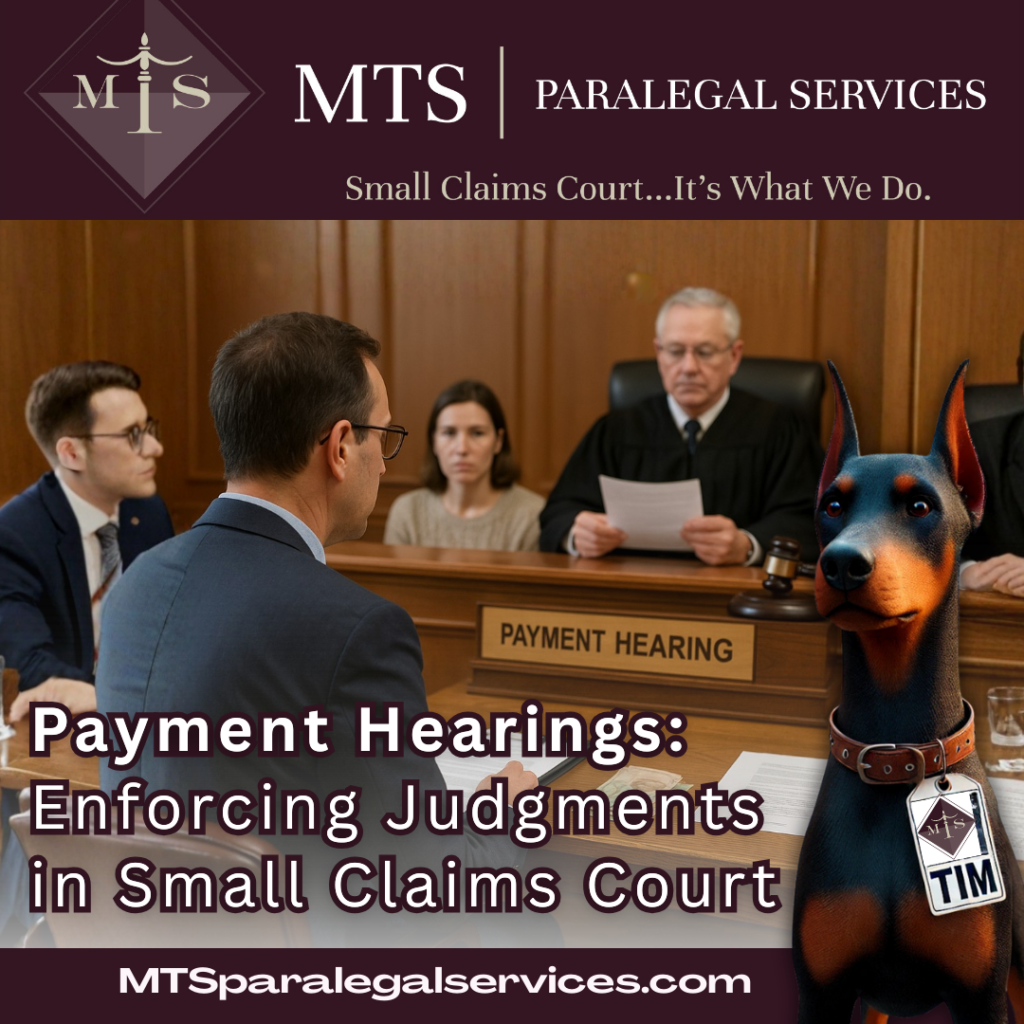
Payment Hearings: Enforcing Judgments in Small Claims Court
In Ontario’s Small Claims Court, obtaining a judgment does not automatically ensure payment. Many judgment debtors fail to pay voluntarily, leaving the successful party with the challenge of enforcement. The payment hearing is one of several enforcement tools available under the Courts of Justice Act and the Rules of the Small Claims Court (O. Reg. 258/98).
A payment hearing allows the creditor to summon the debtor before the court to disclose financial information and establish a realistic payment plan. It serves both informational and enforcement functions—helping the creditor assess the debtor’s ability to pay while providing the court with authority to make binding payment orders.
Tim at MTS Paralegal Services assists creditors in initiating and managing payment hearings to ensure compliance with court orders and effective recovery of judgments.
Initiating a Payment Hearing
Under Rule 20.10 of the Rules of the Small Claims Court, a creditor may request a payment hearing by filing a Notice of Examination (Form 20H). This notice compels the debtor to attend court and provide sworn testimony regarding their financial circumstances.
Before the hearing can proceed, the notice must be served personally on the debtor at least 30 days before the hearing date. The notice must also be accompanied by a blank financial information form (Form 20I), which the debtor is required to complete and bring to the hearing.
The financial information form requests details about:
- Employment and income sources;
- Bank accounts and assets;
- Monthly expenses and dependents;
- Outstanding debts and obligations.
Failure to complete the form or attend the hearing may result in serious legal consequences, including a warrant for arrest or contempt proceedings under Rule 20.11.
Tim at MTS Paralegal Services ensures that notices are properly prepared, served, and filed in accordance with procedural requirements to avoid adjournments or dismissal.
What Happens During a Payment Hearing
A payment hearing is conducted before a deputy judge or court officer who examines the debtor under oath. The purpose is to obtain a full picture of the debtor’s financial situation and determine an appropriate method for satisfying the judgment.
During the hearing, the creditor—or their representative—may question the debtor about employment, income, property ownership, and assets such as vehicles or real estate. Questions may also address whether the debtor has made efforts to pay or whether they are deliberately avoiding payment.
Based on the evidence, the court may issue a payment order, setting out the amount and schedule of payments the debtor must follow. The order is legally binding, and failure to comply may trigger further enforcement action.
Tim at MTS Paralegal Services represents creditors at payment hearings, ensuring questions are strategically framed to uncover all relevant financial details and maximize the likelihood of recovery.
Consequences of Non-Compliance
If a debtor fails to attend the hearing, complete the financial form, or comply with a payment order, the court may issue a default order or a warrant for arrest under Rule 20.11. This does not constitute criminal punishment but is a civil enforcement measure designed to compel compliance with the court’s authority.
Additionally, the creditor may bring a motion for contempt of court, asking the judge to impose penalties such as fines or imprisonment for wilful disobedience of the court’s order. These measures are used sparingly but serve as strong deterrents against disregard for judicial authority.
Tim at MTS Paralegal Services assists in pursuing enforcement remedies when debtors ignore their obligations, ensuring that the creditor’s legal rights are upheld through all available procedural avenues.
Alternative Enforcement Options
While payment hearings are an effective tool, they are not the only method of enforcement available under Ontario law. Depending on the debtor’s circumstances, the creditor may also pursue:
- Wage Garnishment: An order directing an employer to deduct a portion of the debtor’s earnings and remit it to the creditor.
- Bank Garnishment: A court order allowing funds to be seized directly from the debtor’s bank account.
- Writ of Seizure and Sale: Authorizes the sheriff to seize and sell non-exempt assets owned by the debtor.
- Examination in Aid of Execution: Similar to a payment hearing, but focused on identifying specific assets for seizure.
Each enforcement option has its own procedural requirements and timelines. Tim at MTS Paralegal Services evaluates the debtor’s financial profile to determine the most effective strategy for recovery.
Strategic Considerations in Payment Hearings
A successful payment hearing depends on preparation and legal precision. Creditors must:
- File accurate and complete documentation;
- Serve all notices within prescribed timelines;
- Prepare targeted questions about the debtor’s assets, employment, and expenses;
- Bring relevant records, such as bank statements or prior correspondence, to support examination.
The court expects the creditor to conduct the hearing efficiently and respectfully. Excessive or irrelevant questioning may be curtailed by the presiding officer. Tim at MTS Paralegal Services brings procedural expertise and professionalism to ensure compliance with the Rules of the Small Claims Court while advocating effectively for clients’ interests.
Payment Orders and Ongoing Monitoring
Once a payment order is issued, compliance must be monitored closely. If the debtor fails to make payments as required, the creditor may file an Affidavit of Default (Form 20L) and seek further enforcement, such as garnishment.
Payment hearings may also be reconvened if circumstances change—for example, if the debtor’s income increases or new assets are acquired. Continuous monitoring ensures that judgments remain enforceable and that creditors recover the amounts owed in a timely manner.
Tim at MTS Paralegal Services assists in tracking compliance, filing follow-up motions, and initiating further enforcement measures as needed.
Legal Representation from MTS Paralegal Services
Securing a judgment in Small Claims Court marks only the beginning of the enforcement process. When payment is delayed or refused, a payment hearing provides an effective legal avenue for recovering what is owed.
Tim at MTS Paralegal Services, based in Kitchener, Ontario, represents clients across the province in enforcing judgments through payment hearings, garnishments, and other legal remedies. With comprehensive knowledge of Ontario’s enforcement procedures, Tim ensures that every step—from filing to execution—is handled professionally and efficiently.
For assistance with enforcing a judgment or attending a payment hearing, contact Tim at MTS Paralegal Services — Small claims court, it’s what we do. Visit mtsparalegalservices.com for professional representation.
This content does not constitute legal advice. For up-to-date guidance or legal advice specific to your situation, please contact MTS Paralegal Services Professional Corporation or call (226) 444-4882.