
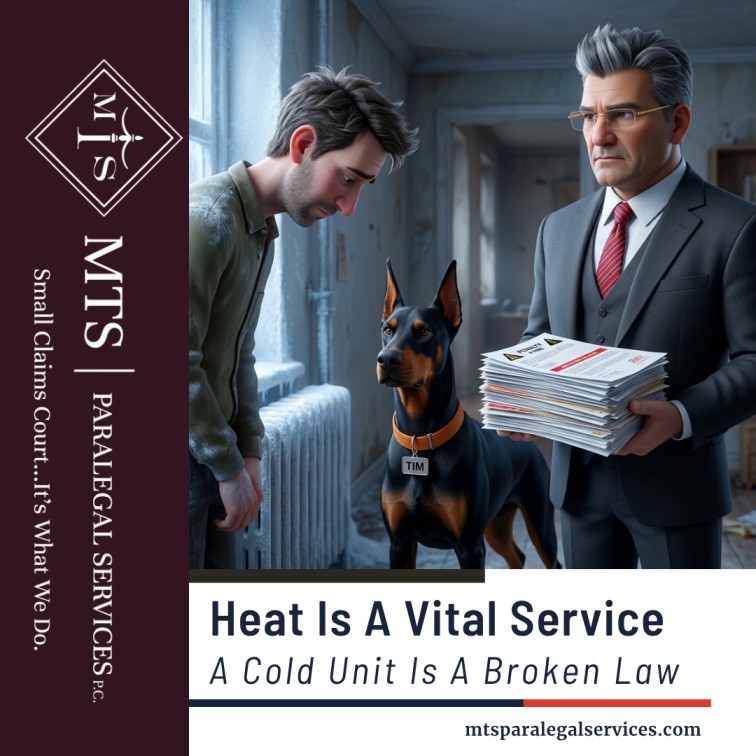
Winter Heat Is the Law, Not a Favour
When the temperature drops and a rental unit stays cold, tenants often feel like they are asking a favour when they request heat. They are not. In Ontario, providing adequate heat is a legal obligation, backed by provincial law and reinforced by municipal bylaws with real teeth. A landlord who leaves a unit cold in winter is not being difficult. They may be breaking the law. Understanding exactly what the law requires, and what a tenant can do when heat falls short, matters most in the coldest months of the year.
MTS Paralegal Services P.C. represents both landlords and tenants before the Landlord and Tenant Board across Kitchener, Waterloo, Cambridge, Guelph, Hamilton, and Southwestern Ontario. Here is what the law says about winter heat.
Heat Is a Vital Service Under Ontario Law
The foundation of a tenant’s right to heat is found in the Residential Tenancies Act, 2006. Section 21 provides that a landlord shall not withhold the reasonable supply of any vital service that it is the landlord’s obligation to supply, nor deliberately interfere with that supply. Heat, during the colder months of the year, is a vital service under Ontario law, alongside hot and cold water, fuel, electricity, and gas. The classification matters because it elevates heat from a mere lease term to a protected necessity that the law will actively enforce.
This is why the framing of heat as a favour is exactly backward. A landlord who is obligated to supply heat cannot switch it off, let a system fall into disrepair, or leave a unit cold as a way of pressuring a tenant. Deliberately withholding a vital service like heat is treated as a serious matter under the Residential Tenancies Act, 2006, and it can expose a landlord to significant consequences. An experienced licensed paralegal can help a tenant establish that a vital service was improperly withheld, and help a landlord understand their obligations before a problem escalates.
The Minimum Temperature: Province and Municipality
Ontario law does not leave adequate heat to interpretation. It sets minimum temperatures. Under the provincial maintenance standards, where a landlord provides heat, the unit must generally be kept to a minimum of 20 degrees Celsius from September 1 to June 15. That provincial floor applies across the province, and it establishes the baseline every landlord must meet during the heating season.
Many municipalities layer a higher standard on top of that floor, and the local bylaw is often the one that actually governs. Toronto, for example, requires a minimum of 21 degrees Celsius from October 1 to May 15, a full degree warmer than the provincial baseline and enforced by the City. Because these municipal standards and heating-season dates vary from city to city, a landlord or tenant in Kitchener, Hamilton, Guelph, or anywhere else in Southwestern Ontario should confirm the specific requirement in their local property standards bylaw. The safe assumption is that both the provincial floor and a potentially higher municipal standard apply, and the higher of the two governs.
What a Tenant Can Do When the Heat Falls Short
A tenant left in a cold unit is not without options, and importantly, withholding rent is not one of them, as raised in the firm’s earlier discussion of what tenants can and cannot do about repairs. The correct first step is always to notify the landlord in writing, clearly and promptly, describing the problem and requesting that the heat be restored to the required temperature. That written record becomes important evidence if the matter escalates, so keeping copies of every message matters.
If the landlord fails to act, two avenues open up and they can be pursued together. A tenant can contact their municipality’s property standards or bylaw enforcement office, often reachable through a service line, to report the lack of heat and have the municipal standard enforced. Separately, a tenant can file an application with the Landlord and Tenant Board, typically a maintenance application, asking the Board to order the landlord to restore proper heat and to grant remedies for the period the unit was inadequately heated. Documenting the indoor temperature with dated readings and photographs of a thermometer strengthens any complaint considerably.
The Consequences for Landlords Who Leave Units Cold
Landlords who fail to provide adequate heat face consequences on more than one front, and they can be severe. Through the Landlord and Tenant Board, a tenant who succeeds on a maintenance application may obtain an order requiring the landlord to restore heat, a rent abatement reflecting the period the unit was too cold, and compensation for related losses. A rent abatement can be substantial where a heating failure persisted through the depth of winter, because the reduction reflects how seriously the tenant’s use and enjoyment of the home was affected.
On top of the Board’s remedies, deliberately withholding a vital service can constitute a provincial offence under the Residential Tenancies Act, 2006, carrying significant fines on prosecution. Municipal bylaw enforcement adds a further layer, and municipal fines for heating violations can be steep. For landlords, the lesson is straightforward. Maintaining the heating system, meeting the minimum temperature, and responding promptly to complaints is not just good practice. It is a legal requirement that protects the landlord as much as the tenant.
Cold Unit This Winter? Know Where You Stand
Heat in winter is not a negotiation and not a courtesy. It is a legal obligation woven through provincial law and municipal bylaws, with real remedies for tenants and real consequences for landlords who ignore it. Whether you are a tenant shivering through a cold snap or a landlord trying to meet your obligations correctly, understanding the rules is the key to resolving the situation the right way. Timothy Ellis of MTS Paralegal Services P.C. has spent over two decades guiding both sides through Landlord and Tenant Board matters across Southwestern Ontario.
Anyone dealing with a heat or vital services dispute can reach the firm through the contact page at mtsparalegalservices.com to find out where they stand.
When the temperature drops, the law does not. Heat is your right.
Small Claims Court… It’s What We Do.
This content does not constitute legal advice. For up-to-date guidance or legal advice specific to your situation, please contact MTS Paralegal Services Professional Corporation or call (226) 444-4882.