
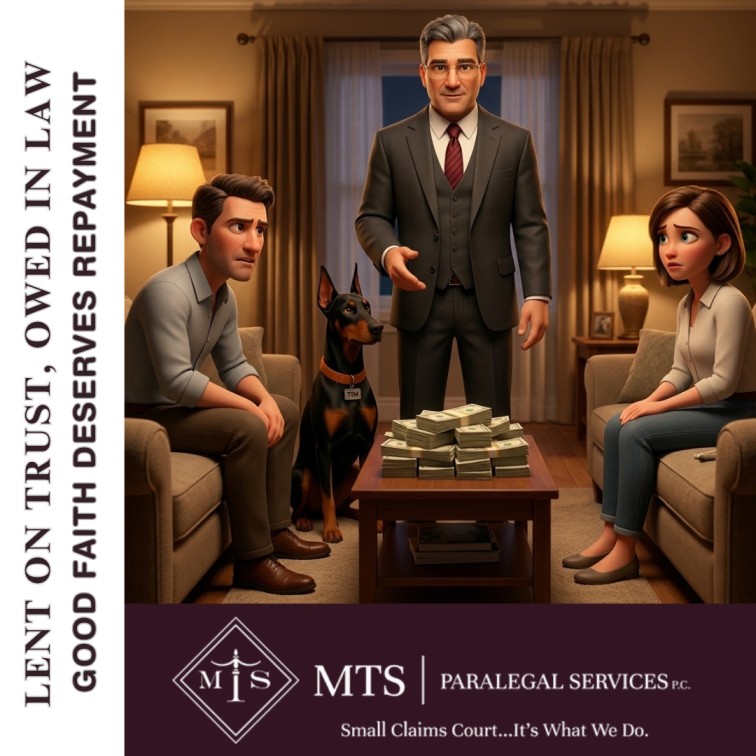
When a Friendly Loan Turns Into a Legal One
It usually starts with good intentions. A friend is short on rent, a sibling needs help with a car, a coworker is between paycheques, and the money changes hands on trust. No contract, no interest, just an understanding that it will be paid back. Then months pass, the repayment never comes, and every reminder makes the friendship a little more strained. Lending money to someone close is one of the most emotionally difficult debts to pursue, and also one of the most legally straightforward. Ontario law does not treat a loan to a friend any differently than a loan to a stranger.
MTS Paralegal Services P.C. helps people across Kitchener, Waterloo, Cambridge, Guelph, Hamilton, and Southwestern Ontario recover money they lent in good faith. When a friendly loan turns into a legal one, here is what matters.
A Loan Is a Loan, No Matter Who Borrowed It
The most important principle to understand is that the relationship between the parties does not change the legal nature of the debt. If money was advanced with a mutual expectation that it would be repaid, a legally enforceable loan was created, whether the borrower was a stranger, a friend, or a family member. The absence of a formal written agreement does not erase that obligation. A verbal loan is still a loan under Ontario law, and it can be pursued through Ontario Small Claims Court like any other debt.
This matters because so many people assume that lending to a friend without paperwork means the money is legally gone if the friendship sours. It is not. The challenge in most personal loan cases is rarely the law itself. It is the evidence. Proving that the money was handed over, that both sides understood it to be a loan, and that repayment was expected is where these cases are won or lost, and it is exactly where careful preparation makes the difference.
The Question That Decides Everything: Gift or Loan?
The single biggest battleground in a personal loan dispute is whether the money was a loan or a gift. A borrower who does not want to repay will frequently claim the money was a gift, given freely with no expectation of return. Because the two are treated completely differently under the law, the entire case can turn on this one distinction. A loan must be repaid. A gift does not. The person seeking repayment carries the responsibility of showing that the money was advanced as a loan.
This is why evidence of the parties’ intentions at the time of the transfer is so valuable. A text message saying pay me back when you can, an e-transfer with a memo describing it as a loan, a partial repayment the borrower already made, or a witness who heard the arrangement discussed all point toward a loan rather than a gift. Partial repayments are especially powerful, because a person does not make payments toward a gift. An experienced licensed paralegal knows how to assemble these threads into a clear picture that answers the gift-or-loan question before the other side can muddy it.
The Evidence That Wins a Loan Claim
Personal loan claims are built almost entirely on documentation, and the good news is that most people have more of it than they realize. Bank statements and e-transfer records establish that the money actually moved from lender to borrower. Text messages and emails discussing the loan, the amount, or the repayment expectation establish the terms and the shared understanding. Any record of partial repayments strengthens the position considerably, as does the identity of any witness who was present when the arrangement was made.
Even a loan with no written agreement at all may be recoverable where the surrounding circumstantial evidence is strong enough. The pattern of the transfer, the communications that followed, and the conduct of both parties can together establish that a loan existed even without a signed document. Before filing, a formal demand letter is the right first step. It puts the borrower on notice, states the amount owed and a deadline, and often produces payment when personal requests have failed, precisely because it signals that the lender is now serious and prepared to act.
Watch the Clock: The Limitation Period Trap
Timing deserves special attention in personal loan cases because of a nuance that catches many lenders off guard. Ontario’s two year limitation period under the Limitations Act, 2002 generally runs from the date the claim was discovered, meaning the point at which it became clear the money would not be repaid. For a loan with a fixed repayment date, that clock typically starts when the borrower misses the agreed date. For an open-ended loan repayable on demand, the analysis can differ, which makes getting timely advice important rather than assuming the deadline is far away.
Waiting too long is a genuine risk. A lender who keeps extending goodwill, accepting excuses, and delaying action for years can find that the window to sue has quietly closed. Ontario Small Claims Court now hears claims up to $50,000, which covers the vast majority of personal loans, but that access only helps a lender who acts within the limitation period. When it becomes clear that a borrower is not going to repay voluntarily, the sensible move is to get an assessment rather than let more time slip by.
Protect the Money, Even When It Hurts the Friendship
Pursuing a loan against someone close is never comfortable, but absorbing the loss is not the only option, and it is rarely the fair one. Ontario law recognizes that a loan made in good faith deserves to be repaid regardless of the relationship behind it. The path forward is methodical: gather the records, establish that it was a loan and not a gift, send a firm demand, and act before the limitation period expires. Timothy Ellis of MTS Paralegal Services P.C. has spent over two decades helping people across Southwestern Ontario recover exactly these kinds of debts with professionalism and discretion.
Anyone owed money on a loan that was never repaid can reach the firm through the contact page at mtsparalegalservices.com to find out where they stand.
You lent it in good faith. You are entitled to get it back.
Small Claims Court… It’s What We Do.
This content does not constitute legal advice. For up-to-date guidance or legal advice specific to your situation, please contact MTS Paralegal Services Professional Corporation or call (226) 444-4882.