
Roommate Skipped on the Rent? Read This
Splitting rent with a roommate is one of the most common ways people afford housing in Ontario. It works beautifully right up until the month a roommate stops paying their share and leaves someone else scrambling to cover the full rent so the whole household does not face eviction. The person left holding the bill is often shocked to learn that the Landlord and Tenant Board may not be the place to sort it out. Understanding why, and where the dispute actually belongs, is the key to getting that money back.
MTS Paralegal Services P.C. helps people across Kitchener, Waterloo, Cambridge, Guelph, Hamilton, and Southwestern Ontario recover money in exactly these situations. A roommate who skipped on the rent is not a loss to absorb quietly.
First Question: Are You Co-Tenants or Is One of You a Roommate?
Everything in a roommate rent dispute turns on the legal relationship between the parties, and there are two very different arrangements that people casually call being roommates. In the first, two or more people signed the same lease with the landlord. They are co-tenants, and their lease almost always makes them jointly and severally liable for the rent. That phrase carries enormous weight. It means the landlord can pursue any one of the co-tenants for the entire rent, regardless of the private arrangement the roommates made between themselves about splitting it.
The second arrangement is different. One person is the tenant on the lease, and the other lives there as an occupant or roommate without being a party to the lease. In that case, the person who is not on the lease has no direct contractual relationship with the landlord at all. The tenant named on the lease remains fully responsible to the landlord for the whole rent, even when the roommate who was supposed to contribute simply stops paying. Sorting out which of these two situations applies is the first thing an experienced licensed paralegal will help pin down, because it shapes everything that follows.
Why the Landlord and Tenant Board Usually Cannot Help
Here is the reality that catches most people off guard. The Landlord and Tenant Board governs the relationship between landlords and tenants under the Residential Tenancies Act, 2006. It does not govern the relationship between roommates. When one roommate fails to pay their share to another roommate, that is a dispute between the two of them, not a dispute between a landlord and a tenant, and the LTB generally has no jurisdiction over it.
This is why a tenant who covered a departed roommate’s share cannot simply file with the Board to get it back from that roommate. The Board deals with what the tenants collectively owe the landlord, not with how the tenants agreed to divide it among themselves. A roommate who is an occupant with no relationship to the landlord falls outside the Board’s reach entirely, and any agreement between the tenant and that occupant is assessed under ordinary contract law rather than the Residential Tenancies Act. That distinction points directly to the correct forum for recovery.
Small Claims Court Is Where Roommate Debts Get Resolved
Because a roommate rent dispute is fundamentally about a broken agreement to share costs, it belongs in Ontario Small Claims Court. The legal foundation is breach of contract. When two people agree to split the rent and one fails to pay their share, the person who covered the shortfall has a claim against the roommate for the amount they were forced to pay on that roommate’s behalf. The agreement to split rent does not need to be a formal written document. A verbal agreement supported by the parties’ conduct is enforceable, though written proof always makes the case stronger.
The same principle applies to a tenant who sued for a roommate’s share of other shared obligations, such as utilities or damage the roommate caused, where an agreement to share those costs existed. Small Claims Court hears these money claims up to $50,000, which comfortably covers any roommate rent dispute a person is likely to face. The court is designed to be accessible, and a well-prepared claim built on clear evidence of the shared arrangement stands a strong chance of success.
Building the Case: Prove the Deal and the Damage
A roommate claim succeeds on two things: proving the agreement to share the rent existed, and proving how much the claimant actually paid to cover the roommate’s default. Evidence of the arrangement includes the lease if both names appear on it, any written roommate agreement, and text messages or emails where the split was discussed and agreed. Even a simple message confirming who pays what and when can establish the deal. Records showing the claimant paid more than their own share, such as bank statements, e-transfers, or rent receipts, prove the loss.
A formal demand letter should come before filing. It sets out what the roommate owes, why they owe it, and a deadline to pay before a claim is started, and it demonstrates to the court that a reasonable effort to resolve the matter was made first. The two year limitation period under the Limitations Act, 2002 applies, so acting reasonably promptly after the roommate defaults protects the right to sue. Where the roommate has moved and is hard to locate, gathering their current contact information early makes serving the claim far easier down the road.
Do Not Let a Roommate’s Exit Become Your Loss
Covering a roommate’s unpaid share to keep a roof overhead is a responsible thing to do, but it does not mean the money is gone for good. The roommate who left the household short still owes their share, and Ontario law provides a clear path to recover it once the right forum is understood. The steps are straightforward: confirm the nature of the arrangement, gather proof of the deal and the payments, send a demand, and file in Small Claims Court before the deadline. Timothy Ellis of MTS Paralegal Services P.C. has spent over two decades helping people across Southwestern Ontario recover money owed under broken agreements of every kind.
Anyone left covering a roommate’s share can reach the firm through the contact page at mtsparalegalservices.com to find out how to get it back.
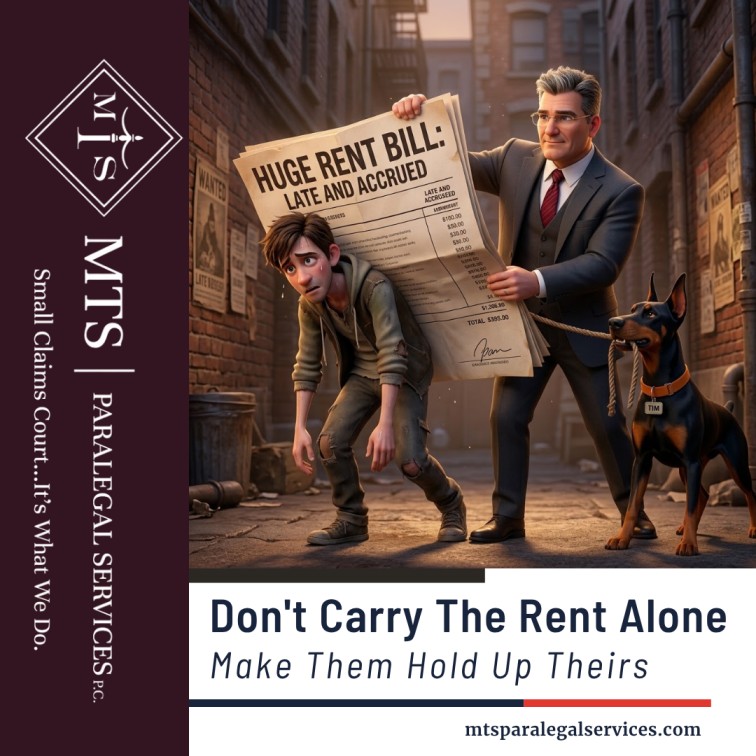
You held up your end. Make them hold up theirs.
Small Claims Court… It’s What We Do.
This content does not constitute legal advice. For up-to-date guidance or legal advice specific to your situation, please contact MTS Paralegal Services Professional Corporation or call (226) 444-4882.