
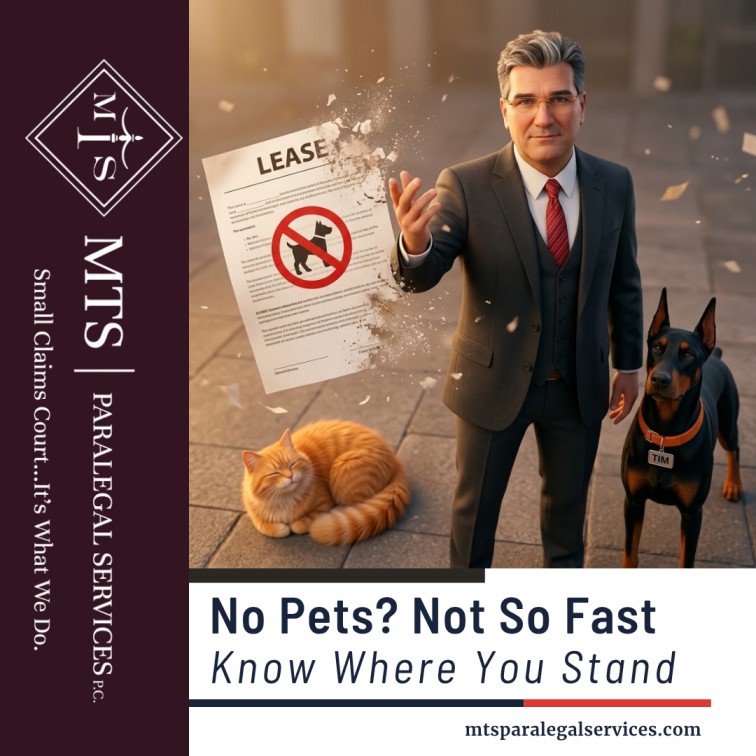
No Pets? Ontario Law Says Not So Fast
It sits right there in the lease, printed in plain language and signed by both parties: no pets allowed. Most tenants read that line and assume it settles the matter. Most landlords write it believing it gives them the power to demand a pet be removed. Both are working from a misunderstanding, because in Ontario that clause is often not worth the paper it is printed on. The law on pets in rental housing surprises people on both sides of the lease, and knowing what it actually says can prevent a great deal of unnecessary conflict.
MTS Paralegal Services P.C. represents landlords and tenants before the Landlord and Tenant Board across Kitchener, Waterloo, Cambridge, Guelph, Hamilton, and Southwestern Ontario. Here is the truth about no pets clauses in Ontario.
The Rule That Catches Everyone Off Guard
Ontario stands alone in Canada on this point. Section 14 of the Residential Tenancies Act, 2006 states that a provision in a tenancy agreement prohibiting the presence of animals in or about the residential complex is void. That single word, void, carries enormous weight. It means the no pets clause has no legal force from the moment the lease is signed, whether or not the tenant agreed to it and whether or not they signed their name directly beneath it.
The practical consequence is significant. A landlord cannot evict a tenant simply for having a pet, and cannot enforce a no pets clause against a tenant who has already moved in. Even a tenant who assured a landlord they had no pets, or who acquired one after signing the lease, cannot be evicted on the basis of the clause alone. A signature does not rescue an unenforceable term. The law treats the clause as if it were never written, and that is true across the vast majority of ordinary rental housing in the province.
Before the Lease Versus After the Lease
There is an important distinction that keeps the picture accurate for both sides. The protection under the Residential Tenancies Act, 2006 applies once a tenancy is formed. Before that point, the calculus is different. A landlord is entitled to ask a prospective tenant whether they have pets and, during the screening process, may choose not to rent to an applicant because of them. There is no obligation to select a pet owner over another applicant.
Once the tenant is accepted and the tenancy begins, however, the landlord’s ability to act on the pet vanishes with respect to the clause itself. This is why the no pets line remains so common on rental listings even though it is generally unenforceable inside a signed lease. A landlord can advertise a preference and screen for it, but cannot use the clause to remove a pet from an existing tenancy. Understanding exactly where that line falls is one of the questions an experienced licensed paralegal helps both landlords and tenants navigate.
When a Landlord Actually Can Act on a Pet
None of this means a landlord is powerless when a genuine problem arises. Section 76 of the Residential Tenancies Act, 2006 sets out the specific circumstances in which a landlord may pursue an eviction connected to an animal, and the focus is always on the pet’s behaviour, not on the existence of a no pets clause. Where an animal causes undue damage to the unit, substantially interferes with the reasonable enjoyment of other residents through issues such as persistent excessive noise, triggers a serious allergic reaction in others in the complex, or is inherently dangerous, the landlord may have grounds to act.
Even then, the process runs entirely through the Landlord and Tenant Board. A landlord cannot simply order the pet gone. The landlord must serve the appropriate notice and apply to the Board, and the Board will only grant an order if it is satisfied that the animal genuinely meets one of these behaviour-based criteria. These applications succeed or fail on evidence about what the specific animal actually did, which is why documentation of noise, damage, or safety concerns matters so much for a landlord, and why a tenant facing such a notice should respond carefully rather than assume the worst.
The Exceptions Worth Knowing
While the general rule is strongly protective of tenants and their pets, a few genuine exceptions exist and both sides should be aware of them. The most significant is condominiums. A condominium corporation’s governing documents, including its declaration and rules, can restrict or prohibit pets, and those restrictions generally apply to everyone in the building, including tenants, because they flow from condominium law rather than from the tenant’s lease. A tenant renting a condo unit is bound by the corporation’s pet rules regardless of what the Residential Tenancies Act, 2006 says about lease clauses.
Two other points round out the picture. Landlords cannot charge a separate pet deposit, because Ontario law limits what a landlord may collect to a rent deposit and a key deposit. And behaviour-based grounds always remain available, meaning even the most pet-friendly rule does not protect an animal that genuinely damages property or endangers others. Between the condominium exception and the behaviour-based grounds, the law strikes a balance, and knowing which rules apply to a specific rental is essential before either side takes action.
Know Where You Stand Before the Fur Flies
Whether you are a tenant worried about a no pets clause or a landlord dealing with a genuine problem animal, the outcome depends entirely on understanding what the law actually permits. A tenant cannot be evicted over a clause the law treats as void, and a landlord cannot act on a pet problem without following the proper process and proving the behaviour-based grounds. Getting the analysis right protects everyone, and it prevents a fixable situation from turning into an unnecessary dispute. Timothy Ellis of MTS Paralegal Services P.C. has spent over two decades guiding both landlords and tenants through Landlord and Tenant Board matters across Southwestern Ontario.
Anyone facing a pet-related tenancy question can reach the firm through the contact page at mtsparalegalservices.com to find out exactly where they stand.
That no pets clause may say one thing. Ontario law says another.
Small Claims Court… It’s What We Do.
This content does not constitute legal advice. For up-to-date guidance or legal advice specific to your situation, please contact MTS Paralegal Services Professional Corporation or call (226) 444-4882.