
No Contract? No Problem. You Can Still Sue
The deal was made over a handshake. The terms were discussed on a phone call. The agreement lived in a few text messages and a mutual understanding that both sides would follow through. Then one side did not, and now the question is whether anything can actually be done about it without a signed contract. The answer surprises most people: yes. Verbal agreements are legally binding in Ontario, and Small Claims Court hears cases built on them regularly.
MTS Paralegal Services P.C. has represented clients in verbal contract disputes across Kitchener, Waterloo, Cambridge, Guelph, Hamilton, and Southwestern Ontario for over 20 years. The absence of a written document does not mean the absence of a case. It means the case is built differently.
Verbal Contracts Are Legally Binding in Ontario
A contract does not need to be written to be enforceable under Ontario law. What makes an agreement legally binding is the presence of the essential elements of a contract: an offer, acceptance of that offer, and consideration, meaning something of value exchanged between the parties. When those elements exist, a binding agreement was formed, whether it was captured in a formal document, a conversation, or a handshake in a driveway.
Ontario courts, including Small Claims Court, recognize and enforce verbal agreements where their existence and terms can be established through evidence. Common examples include personal loans between friends or family members, payment arrangements for services performed, agreements with contractors and tradespeople, and supplier arrangements built on phone calls and a long course of dealing. These disputes come before the court every day, and claimants win them with the right preparation.
The Exceptions: When Writing Is Legally Required
While most agreements can be enforced without a written document, Ontario law does carve out specific exceptions. Under the Statute of Frauds, certain categories of contracts must be in writing to be enforceable. These include contracts for the sale or transfer of land or real estate, guarantees where one person promises to answer for the debt of another, and certain agreements that by their terms cannot be performed within one year.
If a dispute involves one of these categories, the absence of a written agreement creates a genuine legal barrier that requires careful assessment before any claim is filed. For everything outside those categories, including the vast majority of service agreements, loans, and sales of goods, a verbal agreement stands on equal legal footing with a written one. The challenge is not validity. The challenge is proof, and that is where preparation makes all the difference.
Proving a Contract That Was Never Written Down
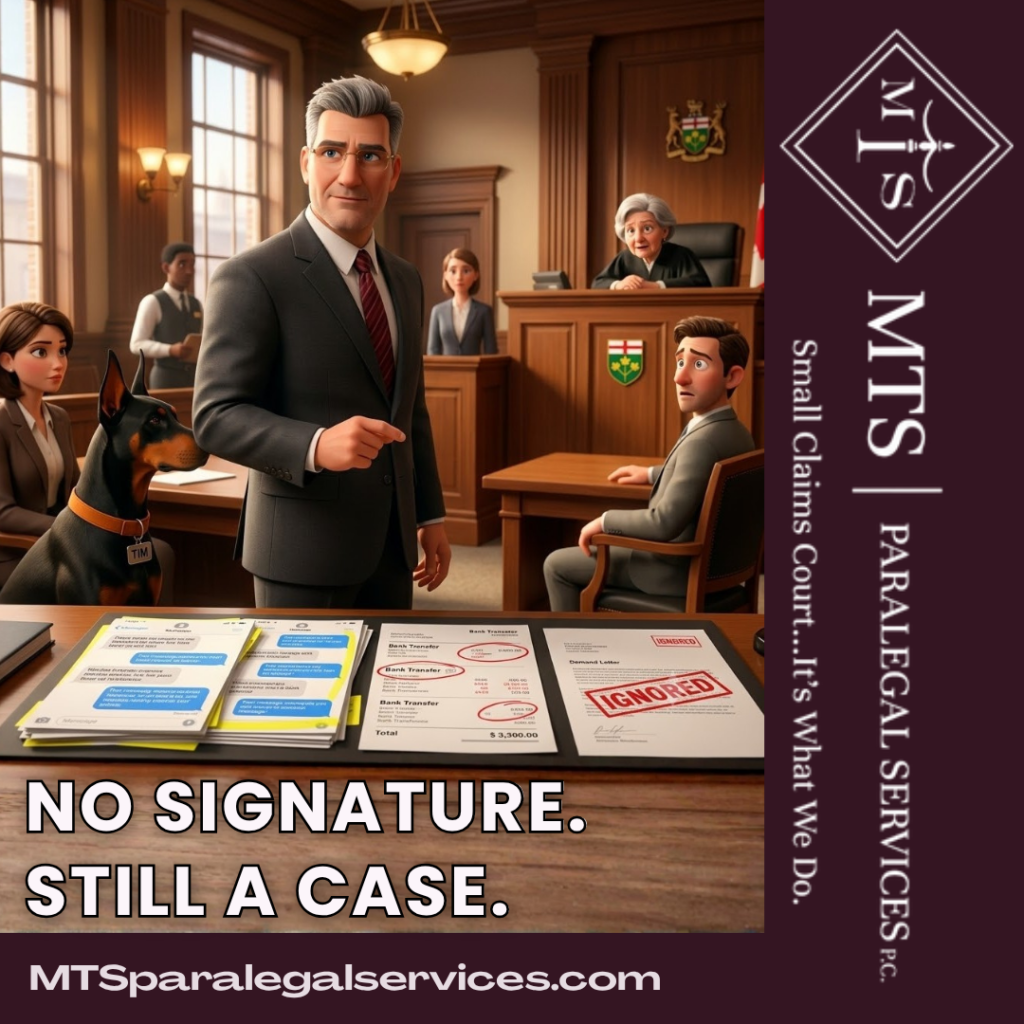
The central battle in any verbal contract case is establishing what was agreed to. Without a signed document, the court relies on the surrounding evidence to determine whether an agreement existed and what its terms were. Text messages and emails discussing the arrangement are often the most powerful evidence available, even when they are informal. Bank records showing payments made, invoices issued, receipts, and delivery records all help establish that both parties acted as though an agreement existed.
Witnesses who were present when the agreement was discussed can also testify about what was said. Perhaps most importantly, the conduct of the parties matters. When one side performed work, delivered goods, or advanced money, and the other side accepted that performance without objection, the court can infer that an agreement existed. MTS Paralegal Services P.C. has explored this topic in depth in its earlier discussion of disputing a breach of verbal contracts in Ontario, and the principles remain the same: the more evidence assembled, the stronger the position.
Act Quickly: The Clock Is Already Running
Verbal contract claims are subject to the same limitation period as written ones. Under the Limitations Act, 2002, a claim must generally be commenced within two years of the date the claimant knew or ought to have known that the breach occurred. The verbal nature of the agreement does not extend that deadline. If anything, it makes acting promptly more important, because memories fade, text threads get deleted, and witnesses become harder to reach as time passes.
The current Small Claims Court jurisdiction of $50,000 covers the overwhelming majority of verbal agreement disputes, from unpaid personal loans to contractor deposits that disappeared. Claimants owed more than the limit can waive the excess and remain in Small Claims Court, or pursue the full amount in the Superior Court of Justice. For most people, the faster and more affordable Small Claims process is the practical choice.
Turn Your Handshake Deal into a Real Claim
A broken promise with no paperwork can feel like a dead end, but Ontario law says otherwise. What matters is whether an agreement existed, whether it was breached, and whether the evidence supports both. Assessing those questions honestly is the first step, and it is exactly where experienced representation earns its value. Timothy Ellis of MTS Paralegal Services P.C. has spent over two decades building and winning cases that started with nothing more than a conversation and a broken commitment.
Before writing off what you are owed, find out what your case is actually worth. Reach out through the contact page or call (226) 444-4882 for an honest assessment.
The deal was real. The money is real. The case can be too.
Small Claims Court… It’s What We Do.
This content does not constitute legal advice. For up-to-date guidance or legal advice specific to your situation, please contact MTS Paralegal Services Professional Corporation or call (226) 444-4882.