
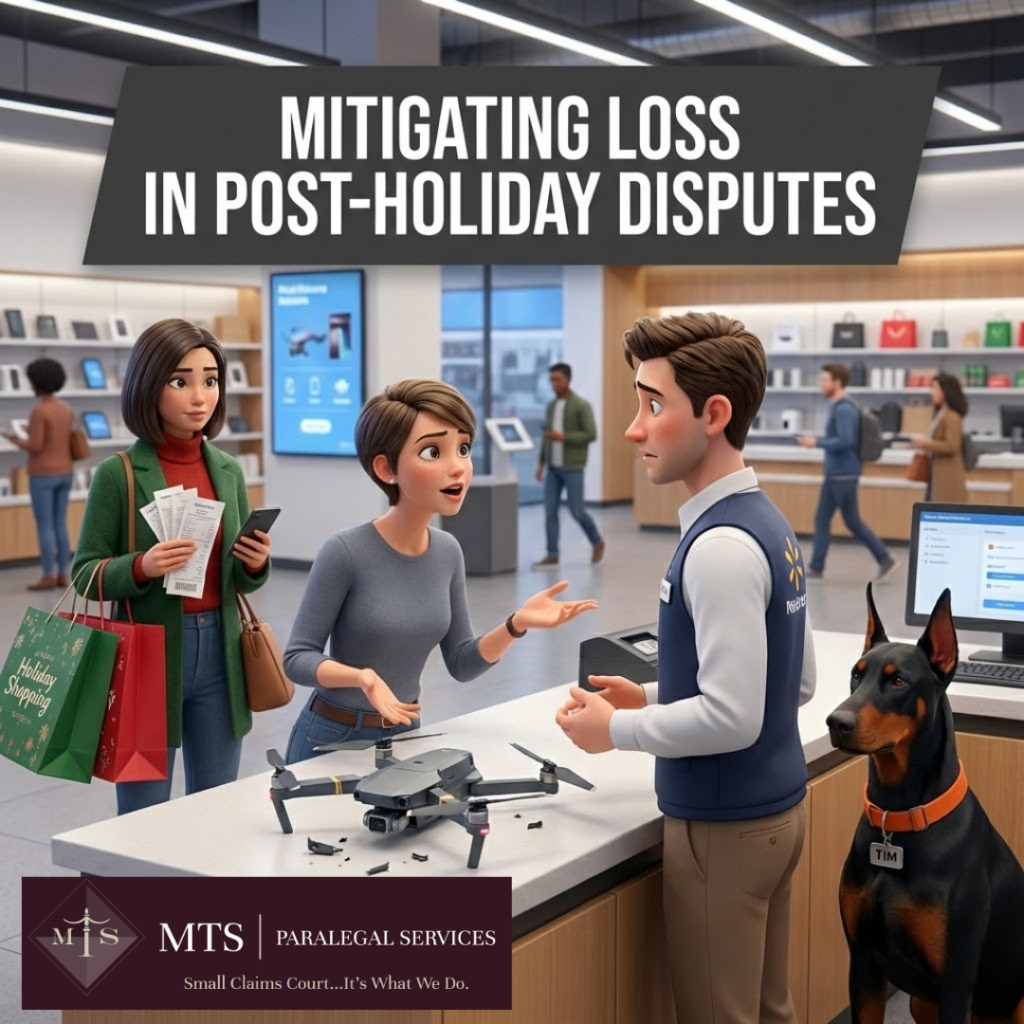
Mitigating Loss in Consumer Disputes After Holiday Spending
The period following the holiday season frequently reveals financial and legal complications arising from consumer transactions. Returns are disputed, services fall short of expectations, warranties are questioned, and payment obligations continue despite dissatisfaction. In Ontario, post-holiday consumer disputes often raise a critical legal issue: mitigation of loss. Consumers are not permitted to remain passive when a transaction goes wrong. Instead, the law expects reasonable steps to reduce financial harm. Legal guidance from professional paralegal firms, including MTS Paralegal Services Professional Corporation, assists consumers in understanding how mitigation operates within Ontario’s legal framework and how rights may be preserved after holiday spending.
The Legal Meaning of Mitigation of Loss
Mitigation of loss is a foundational principle in Canadian contract and consumer law. When a consumer suffers a loss due to defective goods, cancelled services, or unmet contractual terms, the law requires that reasonable efforts be made to limit further damage. This obligation applies even when the consumer is not at fault.
Ontario adjudicators routinely assess whether a consumer acted reasonably after discovering a problem. Failing to seek a refund, continuing to incur avoidable charges, or delaying action may reduce recoverable compensation. Mitigation does not require perfection, but it does require diligence, documentation, and timely response.
Common Post-Holiday Consumer Disputes
Holiday spending disputes frequently involve electronics, travel services, fitness memberships, online purchases, and gift-related transactions. Consumers may discover that products are defective, services are misrepresented, or cancellation policies are more restrictive than expected. In some cases, sellers become unresponsive once the holiday period has passed.
These disputes often escalate because consumers assume dissatisfaction alone justifies full recovery. Ontario law takes a more structured approach. The focus is not only on whether the seller breached an obligation, but also on how the consumer responded once the issue became apparent.
Practical Steps to Mitigate Financial Loss
Mitigation begins with prompt communication. Consumers are expected to notify sellers of defects or concerns within a reasonable timeframe. Written correspondence, such as emails or service requests, creates an evidentiary record that demonstrates proactive conduct.
Returning goods when possible, cancelling services in accordance with stated policies, and avoiding continued use of defective products are all considered reasonable mitigation measures. Retaining receipts, invoices, screenshots, and warranty documentation strengthens a consumer’s position if the dispute proceeds further.
Importantly, mitigation does not mean accepting unfair treatment. It means acting reasonably to prevent losses from increasing while preserving the right to pursue remedies.
How Mitigation Affects Legal Outcomes
In Ontario consumer disputes, mitigation directly influences outcomes. Even where a seller is found to be at fault, compensation may be reduced if the consumer failed to limit losses. Adjudicators often ask whether an alternative course of action could have reasonably reduced the financial impact.
For example, continuing to pay for a service known to be unusable may be viewed as unreasonable. Similarly, refusing a reasonable repair or replacement may weaken a claim for full reimbursement. Understanding how mitigation is evaluated allows consumers to make informed decisions during disputes.
Strategic Considerations Before Escalating a Claim
Before escalating a consumer dispute, it is essential to assess whether mitigation efforts have been adequately documented. Escalation without evidence of reasonable conduct may undermine credibility. Ontario’s dispute resolution processes emphasize fairness, proportionality, and evidence-based decision-making.
Strategic mitigation strengthens negotiating positions and clarifies entitlement. Consumers who demonstrate diligence are better positioned to resolve disputes efficiently, whether through negotiation or formal proceedings.
Turn Holiday Disputes Into Clarity, Connect With MTS
Post-holiday consumer disputes can be frustrating, but legal outcomes often hinge on how losses are managed after the fact. Tim at MTS Paralegal Services Professional Corporation assists consumers across Ontario by evaluating mitigation efforts, assessing dispute strength, and identifying appropriate legal remedies. Those navigating unresolved consumer disputes should contact Tim at MTS to obtain structured legal guidance grounded in Ontario consumer law. When holiday spending goes wrong, smart mitigation keeps losses from lingering long into the new year.
This content does not constitute legal advice. For up-to-date guidance or legal advice specific to your situation, please contact MTS Paralegal Services Professional Corporation or call (226) 444-4882.