
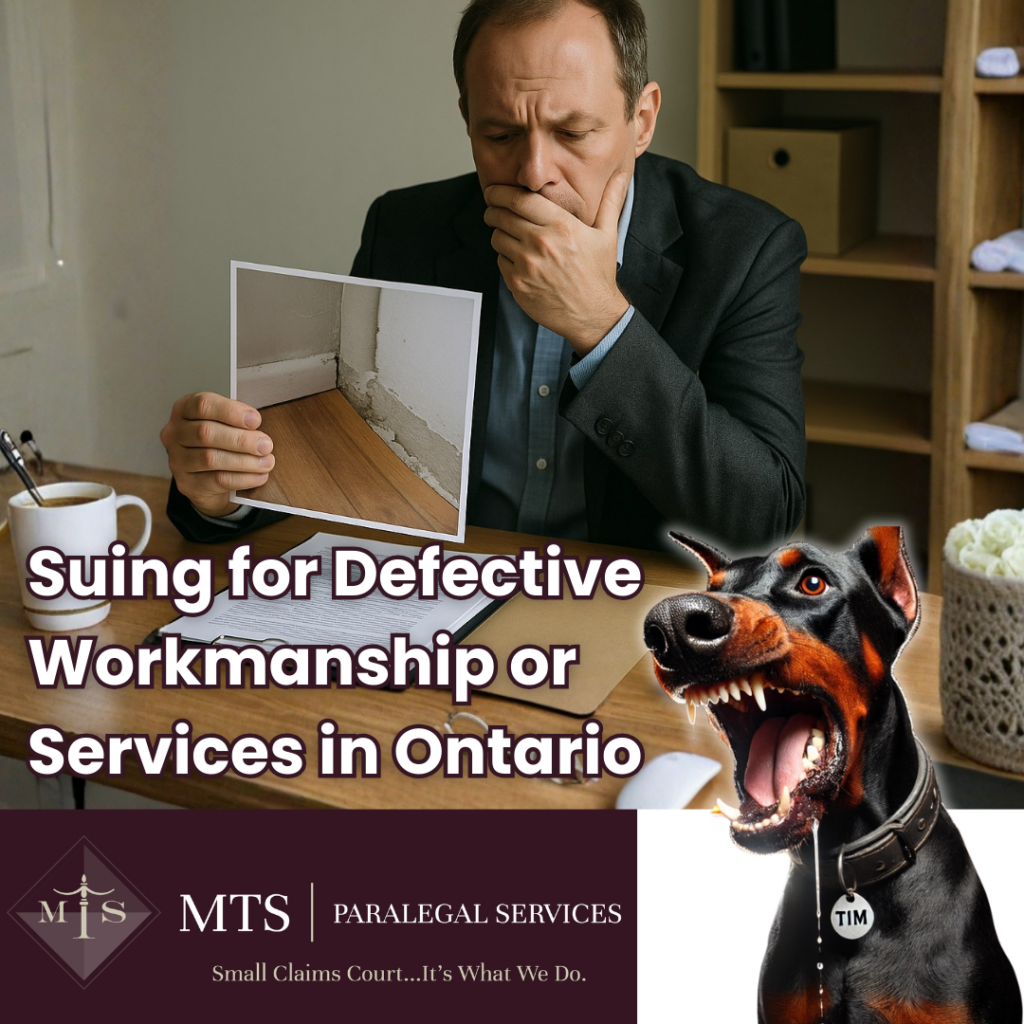
Suing for Defective Workmanship or Services in Ontario
In Ontario, consumers and businesses frequently engage contractors, tradespeople, or service providers for renovation, construction, or professional work. When the result falls below reasonable expectations or contractual terms, it may constitute defective workmanship. This term refers to work that is incomplete, careless, or fails to meet the skill and diligence expected of a competent professional in the same trade.
Legal claims arising from defective workmanship are commonly pursued under the law of contract, negligence, or relevant consumer protection statutes. Tim at MTS Paralegal Services provides professional representation to clients seeking compensation for financial loss, property damage, or breach of agreement resulting from substandard work.
Legal Foundations for Suing Over Defective Work
Defective workmanship claims in Ontario are grounded primarily in two areas of law: contractual breach and negligence.
- Breach of Contract:
A contract, whether written or verbal, establishes specific obligations between the parties. When a contractor or service provider fails to deliver work that conforms to agreed-upon terms or implied conditions, it constitutes a breach. Under Ontario’s Sale of Goods Act and common law principles, every contract for services includes an implied term that the work will be performed with reasonable skill, care, and quality.
A homeowner, for example, who hires a renovation contractor to install flooring and later discovers poor alignment or use of inferior materials, may claim damages for breach of contract. - Negligence:
A negligence claim arises when the service provider owes a duty of care and fails to meet the standard of a reasonably competent professional, causing foreseeable damage. Even without a formal contract, liability can arise if poor workmanship results in harm to property or financial loss.
In both cases, the plaintiff must demonstrate the existence of a duty or contract, a breach of that duty, resulting damages, and a causal link between the breach and the harm suffered.
Evidence Required to Support a Claim
The strength of a defective workmanship claim depends heavily on evidence. Tim at MTS Paralegal Services assists clients in organizing documentation and testimony that establish liability and quantify damages. Typical forms of evidence include:
- Written contracts or estimates outlining the scope of work, materials, and costs.
- Photographs or videos documenting defects, incomplete work, or property damage.
- Expert reports or assessments from qualified tradespersons attesting to the standard of workmanship.
- Invoices, receipts, and correspondence demonstrating payment and communication between parties.
- Repair quotes showing the cost of correcting the defects.
Strong, detailed documentation is crucial for establishing both the existence of an agreement and the extent of damages recoverable through the Small Claims Court or other legal venues.
Remedies Available to Claimants
Ontario law provides several remedies to those affected by defective or incomplete work. The appropriate remedy depends on the nature and severity of the breach.
- Damages:
The most common remedy is monetary compensation for losses directly caused by defective work. This may include the cost of repairs, replacement of materials, or loss of use of the property. - Rescission:
In some cases, a claimant may seek to cancel the contract and recover money paid, particularly where the work is fundamentally defective and cannot be corrected without significant expense. - Specific Performance:
Though less common in service contracts, the court may order the defendant to complete unfinished work in accordance with contractual terms if monetary damages are insufficient. - Consumer Remedies:
Where the dispute involves a consumer transaction, Ontario’s Consumer Protection Act, 2002 may apply. The Act provides additional safeguards against unfair practices, false representations, or failure to perform services of acceptable quality.
Tim at MTS Paralegal Services helps clients assess which remedy aligns with their goals and ensures the appropriate legal arguments and evidence are presented.
The Role of Expert Evidence
In many defective workmanship cases, the quality of the work is a technical question that requires expert input. Courts and tribunals often rely on expert testimony to determine whether the work met the standard of care or fell below industry norms.
For instance, a licensed plumber’s report identifying improper installation of drainage pipes can substantiate a homeowner’s claim for repair costs. Expert evidence adds credibility and helps quantify damages with greater precision.
Tim at MTS Paralegal Services routinely works with independent experts to strengthen clients’ claims and ensure that opinions provided to the court meet admissibility standards.
Time Limits for Bringing a Claim
Claims for defective workmanship are subject to Ontario’s two-year limitation period under the Limitations Act, 2002. The limitation period begins when the defect or loss is discovered, or reasonably should have been discovered, by the claimant.
If a party delays taking action beyond this period, the right to pursue compensation is generally lost. For this reason, clients are encouraged to seek legal advice as soon as a defect or performance issue becomes apparent.
Tim at MTS Paralegal Services assists clients in calculating limitation periods accurately and filing within all procedural deadlines.
Preventing Disputes Through Clear Agreements
While legal remedies exist, prevention remains the most effective strategy. Written contracts should clearly define the scope of work, materials, completion timelines, and payment schedules. Including warranty clauses and inspection rights can reduce the likelihood of disputes.
If disagreements arise, timely communication and documentation can help resolve the issue before legal action becomes necessary. Tim at MTS Paralegal Services provides clients with advice on both resolving disputes informally and, when needed, pursuing formal claims through the court system.
Legal Representation from MTS Paralegal Services
Defective workmanship can lead to significant financial and emotional distress. Ontario law affords strong protections for those who have suffered losses due to negligent or substandard services. Tim at MTS Paralegal Services, located in Kitchener, Ontario, represents clients across the province in pursuing claims for defective workmanship, breach of contract, and negligent service delivery.
With professional experience in the Small Claims Court and administrative tribunals, Tim ensures that every claim is properly prepared, supported by evidence, and filed within legal timelines.
For individuals or businesses seeking redress for defective or incomplete work, timely legal action is critical. Contact Tim at MTS Paralegal Services — Small claims court, it’s what we do. Visit mtsparalegalservices.com for professional legal support.
This content does not constitute legal advice. For up-to-date guidance or legal advice specific to your situation, please contact MTS Paralegal Services Professional Corporation or call (226) 444-4882.